Detecting a disease-causing promoter deletion with ClawBio and Genomic Intelligence
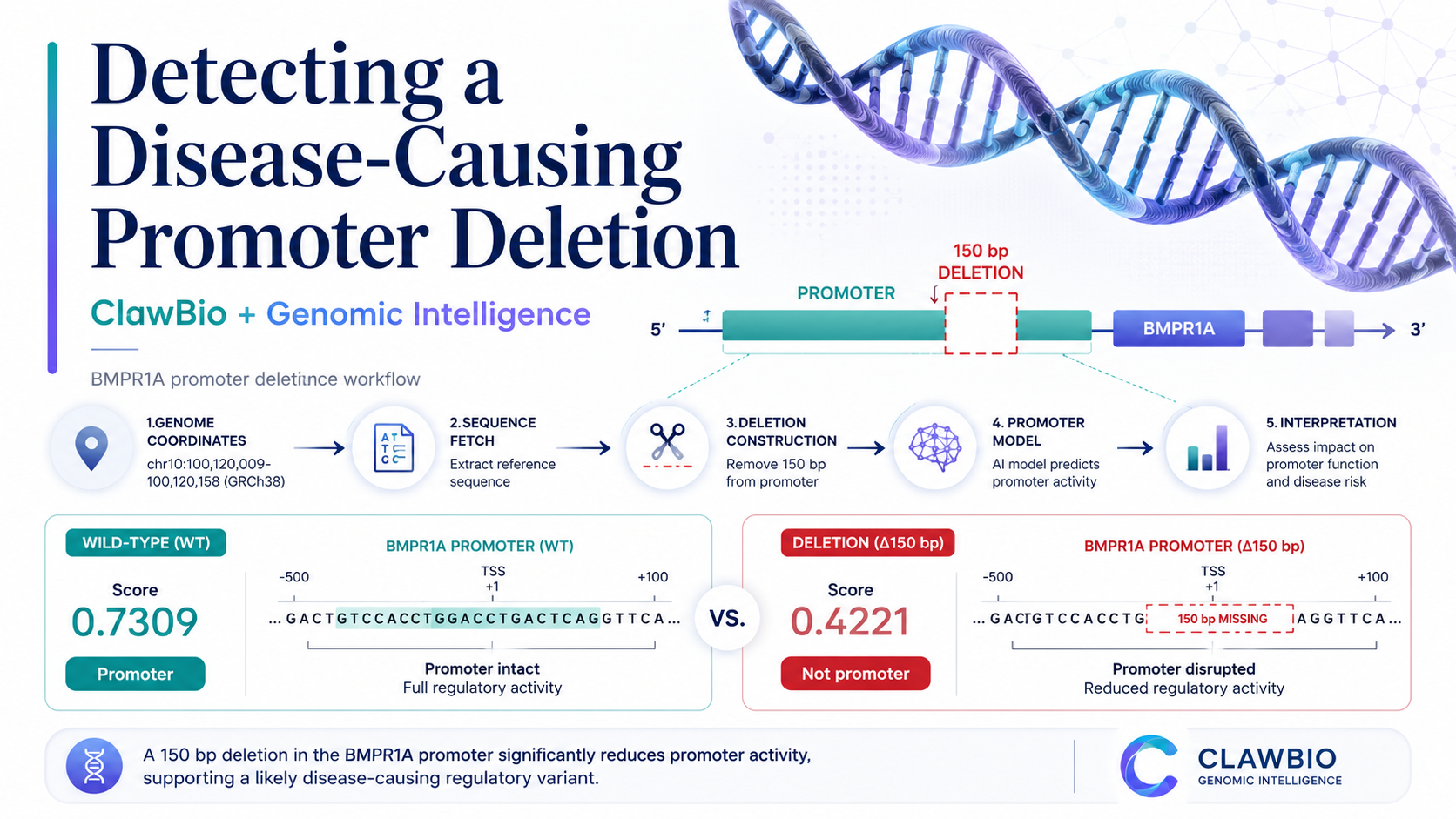
A reproducible ClawBio + Genomic Intelligence workflow: fetch the wild-type BMPR1A promoter, mechanically construct a patient-associated 150 bp deletion, and show the GI promoter model score drop below threshold.
TL;DR
ClawBio lets you run biology-focused AI workflows as Codex or Claude skills.
In this walkthrough, we use the gi-promoter skill from Genomic Intelligence to analyze a real disease-relevant regulatory mutation: a 150 bp deletion in the promoter region of the BMPR1A gene, reported by Calva-Cerqueira et al. in Human Molecular Genetics.
The result is simple but important:
- The wild-type BMPR1A promoter sequence is predicted to be a promoter.
- After introducing the patient-associated 150 bp deletion, the promoter score drops below the model threshold.
This post continues our series on ClawBio + Genomic Intelligence skills.
If you want to learn more about ClawBio or Genomic Intelligence, join our upcoming webinar: luma.com/6mov0cxa.
What is ClawBio?
ClawBio is a collection of biology-oriented skills for AI coding agents such as Codex or Claude Code.
Each skill is a self-contained workflow that includes instructions, code, examples, validation rules, and reproducibility support.
Instead of asking an AI agent to invent a bioinformatics workflow from scratch, you point it to a skill in the ClawBio repository: github.com/ClawBio/ClawBio.
The skill tells the agent how to extract the sequence, how to call the genomic model, and how to save outputs.
This matters because biological workflows are easy to get subtly wrong.
In this example, we want the agent to:
- fetch the correct human genome interval;
- use the correct strand;
- preserve exact sequence coordinates;
- generate the deletion sequence mechanically;
- call the predictive model;
- avoid manual copy-paste errors;
- save a reproducible report.
What is Genomic Intelligence?
Genomic Intelligence is a platform for sequence-to-function prediction.
In this example, we use the GI promoter model through the ClawBio gi-promoter skill.
The model takes a DNA sequence and predicts whether it contains promoter activity.
This lets us ask two practical questions:
- Does this DNA sequence look like a promoter?
- And more importantly: does this patient deletion destroy the promoter signal?
What we are going to do
This example comes from juvenile polyposis, an inherited cancer-predisposition syndrome.
Standard genetic testing often focuses on protein-coding regions. But this case shows why that is not always enough.
The disease-causing change is not in the protein-coding sequence. It is in a promoter — a regulatory DNA switch needed to turn the gene on.
Using ClawBio in Codex, we will run a small diagnostic-style workflow:
- Fetch the wild-type BMPR1A promoter sequence from hg38.
- Save it as
BMPR1A_promoter_WT.fa. - Generate a mutant sequence by deleting the 150 bp region reported in the patient.
- Save it as
BMPR1A_promoter_mut.fa. - Run the GI promoter model on both sequences.
- Compare the model outputs.
We will use this exact genomic interval:
Genome: GRCh38 / hg38
Chromosome: chr10
Coordinates: chr10:86755959-86756926
Strand: forward
Coordinate system: 1-based inclusive
RefSeq accession: NC_000010.11
This coordinate range is important. It fetches the complete 968 bp BMPR1A promoter sequence used in this example.
Step 1. Ask Codex to fetch the BMPR1A promoter sequence
Here is the prompt:
Use the ClawBio skills located in skills/.

Task:
Fetch the BMPR1A promoter sequence from hg38 and prepare FASTA file.

Use this exact region:
- Genome: GRCh38 / hg38
- Chromosome: chr10
- Coordinates: chr10:86755959-86756926
- Strand: forward
- Coordinate system: 1-based inclusive
- RefSeq accession, if needed: NC_000010.11

Requirements:
- Read the relevant skill instructions first.
- Use the local ClawBio / ncbi-datasets methodology if available.
- Do not download the whole genome for this small interval.
- Fetch the exact 968 bp sequence.
- Save the fetched sequence as:
  results/BMPR1A_promoter_WT.fa
- Use uppercase A/C/G/T in the saved FASTA.
- Validate that the FASTA is single-record and exactly 968 bp.
- Report the sequence length, GC content, and source accession.
Expected result:
Created:
results/BMPR1A_promoter_WT.fa

WT length: 968 bp
Source: GRCh38 / hg38 chromosome 10, NC_000010.11
Step 2. Generate the patient-deletion sequence
The patient deletion removes this exact 150 bp sequence from the wild-type promoter:
GCAGGCGCCCGTGGTCGGGTGCGCGCGGCGCGGGCGGGGGCCTTCCCAGTGCGCGCGCGCCGTGCAAGGCCCGCGGACGCCCGCCCCTCCCCCAGGCCCCCGCACCCGCGCCGCCCCCTCCCCTCCTGGCAAGAGTCGGCGGCGGTGGCGNow ask Codex to generate the mutant FASTA mechanically:
Now generate a mutant FASTA by deleting the following exact 150 bp sequence from
results/BMPR1A_promoter_WT.fa:

GCAGGCGCCCGTGGTCGGGTGCGCGCGGCGCGGGCGGGGGCCTTCCCAGTGCGCGCGCGCCGTGCAAGGCCCGCGGACGCCCGCCCCTCCCCCAGGCCCCCGCACCCGCGCCGCCCCCTCCCCTCCTGGCAAGAGTCGGCGGCGGTGGCG

Save the mutant FASTA as:
results/BMPR1A_promoter_mut.fa

Requirements:
- Match the deletion sequence case-insensitively.
- Confirm that the deletion sequence occurs exactly once in the WT sequence.
- Remove it mechanically from the WT sequence.
- Do not manually rewrite the mutant sequence.
- Save the fetched sequence as:
  results/BMPR1A_promoter_mut.fa
- Validate:
  - WT length
  - deletion length
  - deletion start and end positions in WT
  - mutant length
  - that the deletion sequence is absent from the mutant
Expected validation:
WT length: 968 bp
Deletion length: 150 bp
Deletion position in WT: 531-680
Mutant length: 818 bp
Deletion occurs in WT: once
Deletion occurs in mutant: zero times
Mutant equals WT with exact deletion: true
The genomic coordinates of the deleted region are:
chr10:86756489-86756638Step 3. Run the GI promoter model
Now we can ask Codex to evaluate the mutation effect.
Use the ClawBio skill located at skills/.

Task:
Determine how the 150 bp deletion affects BMPR1A promoter activity.

Inputs:
- WT FASTA: results/BMPR1A_promoter_WT.fa
- Mutant FASTA: results/BMPR1A_promoter_mut.fa

Expected output:
WT promoter score: 0.7309
WT call: Promoter
Deletion promoter score: 0.4221
Deletion call: Not promoter
Model threshold: 0.5
Relative score reduction: 42.3%
The key result:
WT promoter score: 0.7309
WT call: Promoter
Deletion promoter score: 0.4221
Deletion call: Not promoter
Model threshold: 0.5
Relative score reduction: 42.3%
The wild-type sequence is predicted to be a promoter.
The 150 bp deletion drops the score below the promoter threshold.
Step 4. Interpret the result
Codex can now write a concise diagnostic-style interpretation.
Write a concise diagnostic-style interpretation of the BMPR1A promoter deletion result.

Include:
- what sequence was analyzed;
- what deletion was introduced;
- WT promoter score and call;
- mutant promoter score and call;
- whether the deletion crosses the promoter threshold;
- whether the result is consistent with Calva-Cerqueira et al.;
- why this matters for non-coding variant interpretation.

Use language understandable to clinicians and geneticists who are not machine-learning specialists.
Expected interpretation:
The wild-type BMPR1A promoter sequence from chr10:86755959-86756926 is predicted to contain promoter activity, with a promoter score of 0.7309.
After deleting the 150 bp patient-associated segment at chr10:86756489-86756638, the promoter score decreases to 0.4221, below the model threshold of 0.5.
The model call changes from “promoter” to “not promoter.”
This provides in-silico evidence that the deleted region is important for BMPR1A promoter identity. The result is consistent with the experimental findings of Calva-Cerqueira et al., who showed that BMPR1A promoter-disrupting mutations can reduce promoter activity and explain juvenile polyposis cases that are missed by standard coding-region testing.
This example illustrates how AI-based promoter annotation can help prioritize disease-causing non-coding variants.
What this workflow demonstrates
This example shows three useful things.
First, a disease-causing mutation does not need to change a protein. It can disrupt a regulatory element that controls gene expression.
Second, the GI promoter model can provide functional evidence for non-coding variants. In this case, the model detects promoter activity in the wild-type BMPR1A sequence and loss of promoter signal after the patient deletion.
Third, ClawBio makes the workflow reproducible. The agent does not only summarize the biology. It fetches the reference sequence, creates FASTA files, validates sequence lengths, runs the model, saves outputs, and writes a report.
The workflow is:
genomic coordinates
→ reference sequence fetch
→ patient deletion construction
→ promoter model
→ WT vs deletion comparison
→ diagnostic interpretation
Important limitations
This is not a standalone clinical diagnosis.
A real diagnostic workflow would also require:
- clinical phenotype review;
- variant confirmation in the patient;
- genome-build and coordinate validation;
- family segregation analysis;
- population-frequency checks;
- orthogonal laboratory validation;
- ACMG-style evidence assessment;
- review by qualified clinical genetics professionals.
The promoter model should be treated as functional evidence and variant-prioritization support, not as a replacement for clinical interpretation.
But as a reproducible demonstration, the result is powerful: the model detects the normal BMPR1A promoter and shows that the patient deletion removes the promoter signal.
References and background
Tools and platforms
- Genomic Intelligence — genomicintelligence.ai
- ClawBio GitHub repository — github.com/ClawBio/ClawBio
- OpenAI Codex — openai.com
- Cursor IDE — cursor.com
- Previous tutorial — Using ClawBio and Genomic Intelligence Skills to Predict Gene Expression and Optimize Promoters
Biological paper
Calva-Cerqueira et al. Discovery of the BMPR1A promoter and germline mutations that cause juvenile polyposis. Human Molecular Genetics. 2010. doi:10.1093/hmg/ddq396
Molecular biology concepts
- Promoter
- Gene expression
- BMPR1A
- Juvenile polyposis syndrome
- FASTA format
- Non-coding DNA
Conclusion
Standard genetic testing often focuses on protein-coding regions. But some real disease-causing mutations sit outside genes, in regulatory DNA.
The BMPR1A juvenile polyposis example shows how this can happen.
The wild-type sequence is predicted to be a promoter. The patient-associated 150 bp deletion drops the promoter score below the model threshold.
With ClawBio, the whole analysis can be run as a reproducible agentic workflow: reference-sequence fetching, FASTA generation, validation, model prediction, and interpretation.
This is a practical example of how genome-scale AI can open a new layer of diagnostics beyond genes alone.