Expression prediction is live on the platform
The gene-expression task is now available in the DNA Analysis Platform and the /v1 API.
Our gene-expression model is now serving in production. You can run it from the
DNA Analysis Platform or call it directly
through the /v1/tasks/expression/predict endpoint.
Expression joins the existing tasks — promoter, splice, enhancer, chromatin, and annotation — bringing the platform to six inference tasks plus a composite annotation-to-expression workflow.
What the model takes as input
The expression model reads two inputs:
- A gene — supplied as a DNA sequence centered on the gene’s transcription
start site (TSS). On the platform you can pick a gene by symbol (for example
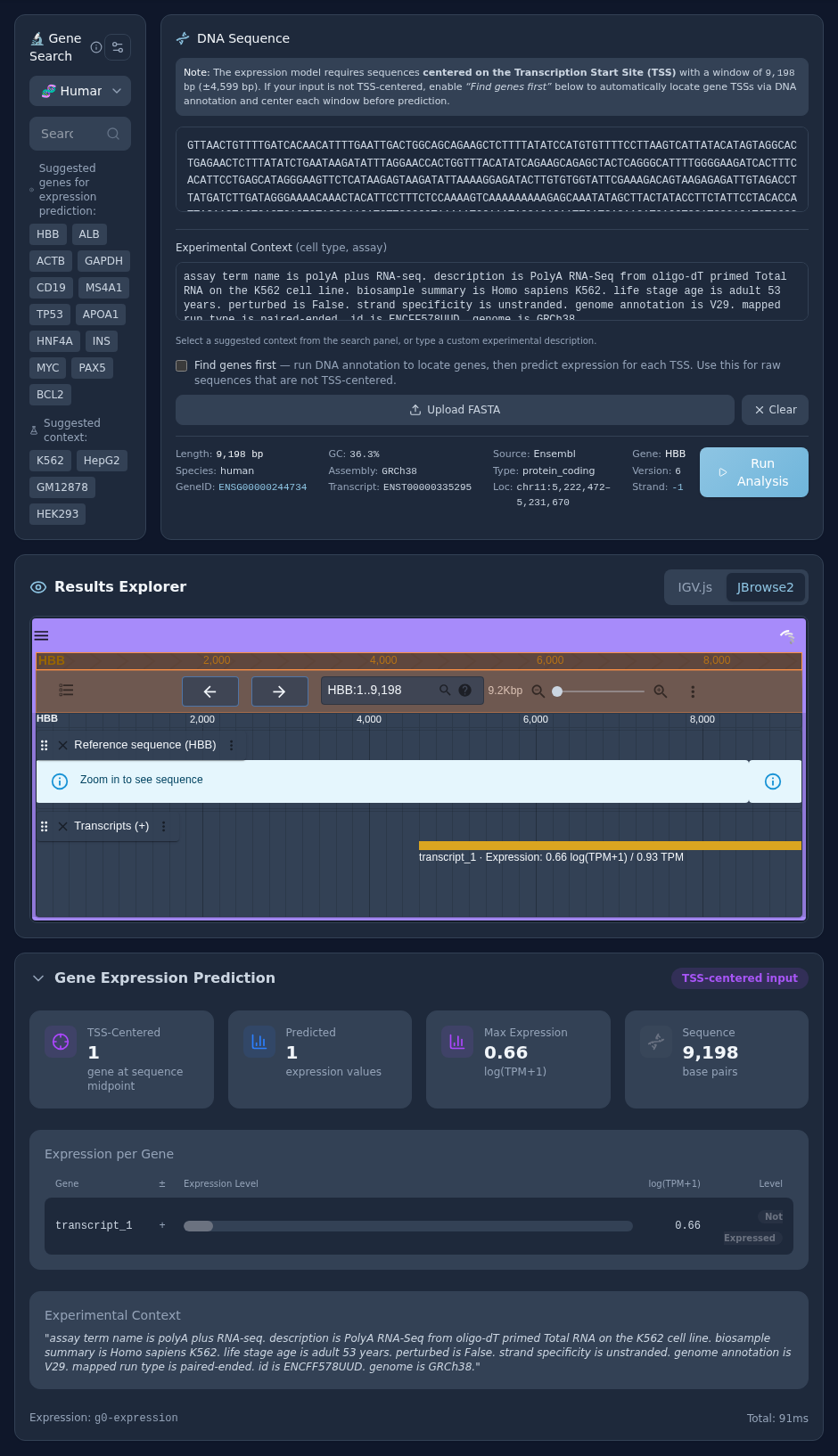
HBB) and the app fetches and centers a 9,198 bp window (±4,599 bp around the TSS) for you. You can also paste raw sequence or upload a FASTA; if it is not TSS-centered, enable Find genes first to locate the TSS and window it automatically. - An experimental context description — a natural-language description of the biological and experimental setting you want the prediction for (cell type, assay, and related metadata). The model conditions its expression estimate on this text, so the same gene can be scored under different contexts.
Given a gene and a context, the model returns a predicted expression level per
transcript, reported both as log(TPM+1) and as TPM.
An experimental-context example
Here is the K562 RNA-seq context used by the platform’s built-in HBB example. It follows the ENCODE-style, attribute-per-clause phrasing the model was trained on:
assay term name is polyA plus RNA-seq. description is PolyA RNA-Seq from
oligo-dT primed Total RNA on the K562 cell line. biosample summary is Homo
sapiens K562. life stage age is adult 53 years. perturbed is False. strand
specificity is unstranded. genome annotation is V29. mapped run type is
paired-ended. id is ENCFF578UUD. genome is GRCh38.
K562 is a chronic myelogenous leukemia cell line (blood/erythroid lineage). Edit any field of this text to score the same gene under a different experimental context: swap the cell line, the assay, or the annotation. The description is free text, so treat this as an illustrative template rather than a fixed schema.
Running the HBB example
Selecting the HBB gene with the K562 context above and running the prediction produces a per-transcript expression estimate, visualized on the genome track and summarized alongside the input specification.
See the task reference for input formats and output schemas to start scripting against it.