Gene Finding is live: predicting transcript intervals from DNA
Gene Finding is now available as an interactive task on the DNA analysis platform, predicting transcript intervals directly from sequence — walk through a worked example over the MYC locus.
Gene Finding is now available as an interactive task on the Genomic Intelligence DNA analysis platform at app.genomicintelligence.ai. Given a stretch of DNA, the model predicts where transcripts lie directly from sequence, with no alignment to a reference annotation: the start and end coordinates of each transcript interval, and the strand it sits on. It is the structural first step of reading a genome. Before you can ask what a region does, you need to know which parts of it are transcribed and where those units begin and end.
What the model takes as input
Gene Finding runs on a single DNA sequence. On the platform you can supply that
sequence any way that is convenient: pick one of the built-in gene examples
(MYC, TP53, BRCA1, EGFR, CFTR), search for a gene symbol or a chr:start-end
coordinate range to pull the sequence straight from Ensembl, paste raw
nucleotides, or upload a FASTA file. You then choose an annotation model — the
platform offers a G0 and a G1 annotation model — and run the analysis.
The model scans both strands and returns the transcript intervals it predicts
along your input.
A concrete example: the MYC locus
To see a real result, I loaded a 7,000 bp window on chromosome 8 spanning the
MYC locus (chr8:127,735,000–127,742,000, GRCh38) via the coordinate
search, selected the G0 Annotation model, and clicked Run Analysis. The
prediction returned in a few seconds.
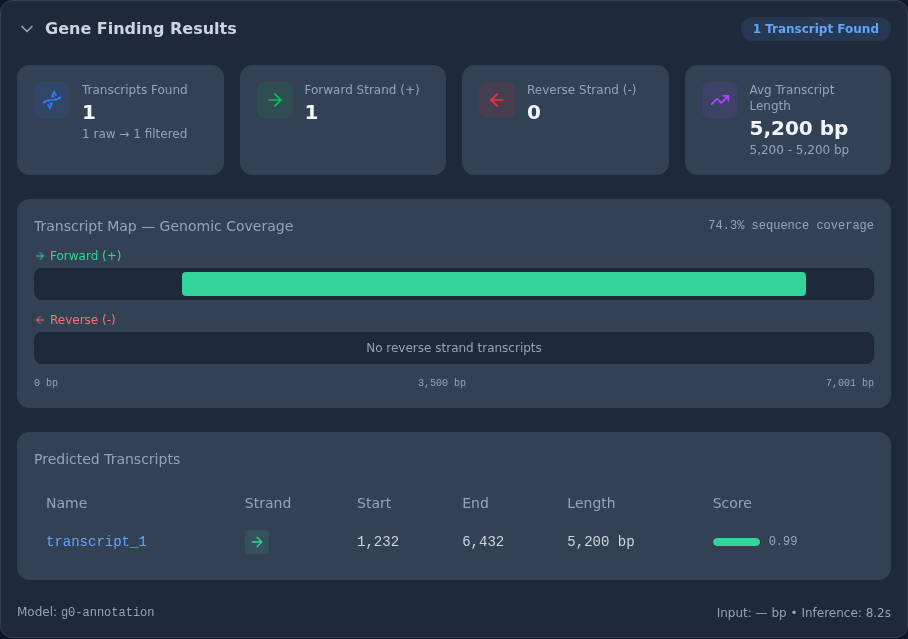
The Gene Finding Results panel opens with a 1 Transcript Found badge and a
row of summary cards: Transcripts Found reads 1 (1 raw → 1 filtered),
Forward Strand (+) 1, Reverse Strand (−) 0, and Avg Transcript Length
5,200 bp. Beneath them, the Transcript Map — Genomic Coverage lays the input
out as a 0–7,001 bp axis and draws the prediction on it: a single block on the
forward strand covering 74.3% sequence coverage, with the reverse strand track
reading No reverse strand transcripts. The Predicted Transcripts table gives
the exact call — transcript_1, + strand, start 1,232, end 6,432, length
5,200 bp, score 0.99 — the same interval drawn in the map above. The footer notes
the run used the g0-annotation model with an inference time of 8.2 s.
Everything the model reported here came from the sequence alone: it located one forward-strand transcript inside the window and placed its boundaries, without being told where MYC is.
These are computational predictions intended for research and development, not clinical or diagnostic decisions. Try Gene Finding — on the built-in examples and your own sequences — at app.genomicintelligence.ai.