Genomic Intelligence models are now available in Biomni Lab
Biomni can now call Genomic Intelligence sequence-to-function models inside natural-language research workflows — turning promoter design, expression prediction, and variant interpretation into agent-executable tasks.
Biomni Lab is built around a simple idea: scientists should be able to move from a biological question to a reproducible computational workflow without stitching together APIs, scripts, models, databases, and infrastructure by hand.
Genomic Intelligence brings a complementary capability into that workflow: sequence-to-function models that read DNA sequence and predict biological activity. With this integration, Biomni can now use Genomic Intelligence models inside natural-language research workflows, turning promoter design, expression prediction, regulatory sequence search, and variant interpretation into agent-executable tasks.
Get started
To connect Genomic Intelligence models in Biomni Lab:
- Open Settings.
- Go to External integrations.
- Enable Genomic Intelligence.
- Paste this demo key:
gi_ujbfpL9-RNRHk9HvKcANCZCylMzsjlsbThe demo key supports a limited number of inquiries. If you hit the limit, please contact us at genomicintelligence.ai.
Once connected, describe the biological sequence-function task in natural language:
Design a promoter with high predicted expression in [target context]
and low predicted expression in [off-target context].

Start from plausible endogenous human promoters.
Use Genomic Intelligence expression scoring.
Optimize selectivity with SNVs only.
Save candidates, scores, the best sequence, and a report.
Why Genomic Intelligence
DNA sequence contains a large fraction of the regulatory information that controls when, where, and how strongly genes are expressed. But interpreting that information remains one of the central bottlenecks in biology. Researchers can sequence genomes cheaply, but predicting what a sequence will do in a specific biological context is still difficult, slow, and often dependent on repeated wet-lab cycles.
Genomic Intelligence builds genomic foundation models for this sequence-to-function layer. These models take DNA sequence as input and predict functional outputs such as gene expression, promoter activity, enhancer activity, splice-site behavior, chromatin features, gene annotation, and regulatory variant effects.
Bringing these models into Biomni means they can be used as part of a broader scientific workflow. A researcher can describe the biological context, specify target and off-target conditions, ask Biomni to score candidate regulatory sequences, optimize them, save the outputs, and produce a reproducible report.
How the integration works
Biomni can call Genomic Intelligence models as model-backed scientific tools. The agent reads the task, identifies the relevant GI endpoint, checks the input constraints, writes the scoring and optimization code, runs model calls, tracks intermediate results, and returns both the final answer and the files needed to inspect or reproduce the workflow.
This matters because sequence design is rarely a single model call. A useful workflow often includes:
- Choosing biologically plausible starting sequences.
- Scoring each sequence in target and off-target contexts.
- Defining a quantitative objective.
- Iteratively optimizing the sequence while preserving model constraints.
- Saving the candidate sequences, score table, best design, and report.
- Stating caveats and next validation steps.
Biomni handles that orchestration, while Genomic Intelligence provides the sequence-to-function model predictions.
Example: designing a glioblastoma-selective promoter
As a first test, we asked Biomni to design a promoter or regulatory sequence with high predicted expression in glioblastoma stem-like cells and low predicted expression in normal adult brain.
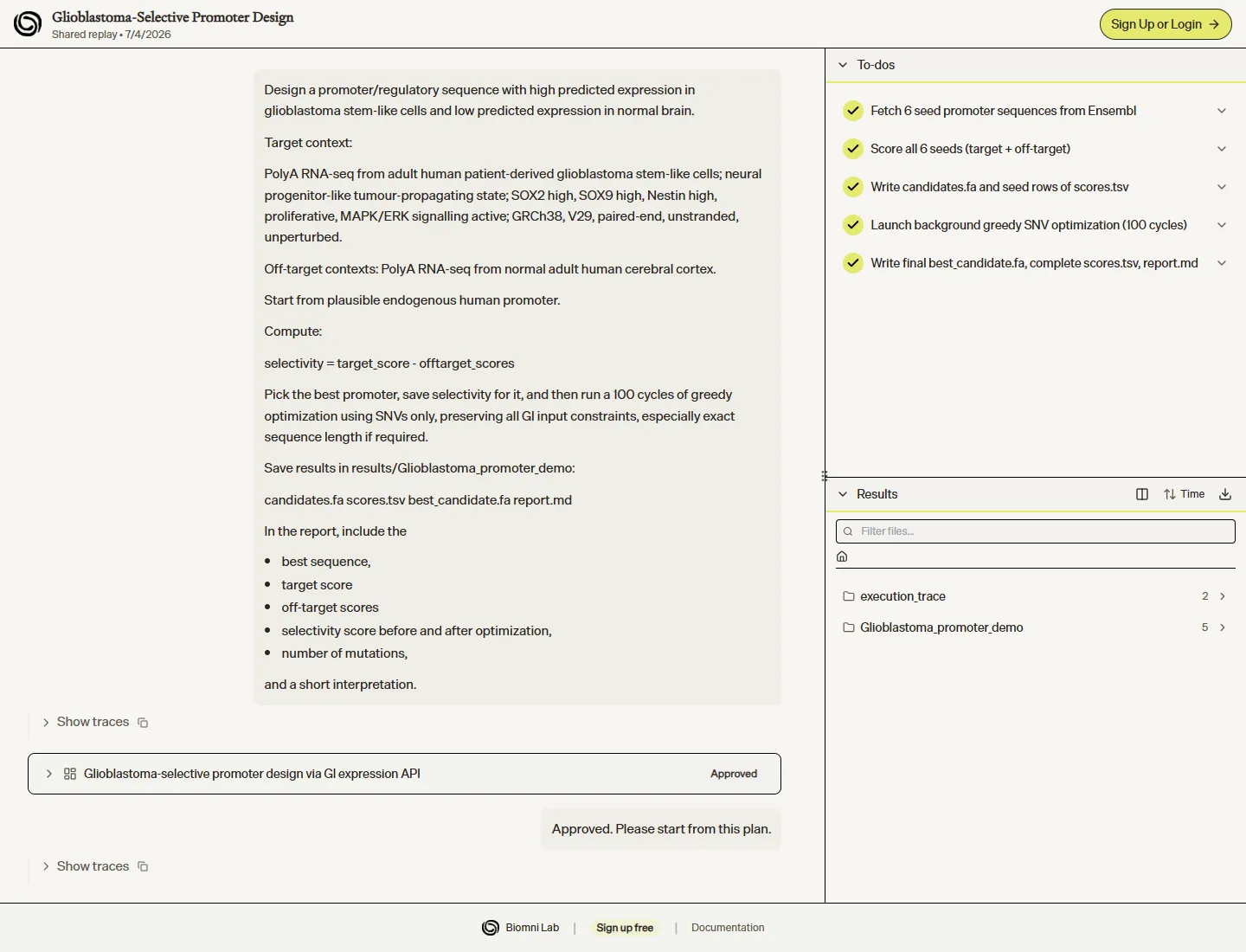
The prompt specified a target context:
PolyA RNA-seq from adult human patient-derived glioblastoma stem-like cells; neural progenitor-like tumour-propagating state; SOX2 high, SOX9 high, Nestin high, proliferative, MAPK/ERK signalling active.
The off-target context was normal adult human cerebral cortex. Selectivity was defined as:
selectivity = target_score - off_target_scoreBiomni then used the Genomic Intelligence expression model as the scoring oracle. It started from six endogenous human promoter candidates: SOX2, SOX9, NES, PROM1, FOXM1, and MKI67. Each was scored in both contexts using a fixed 9,198 bp TSS-centered input window.
FOXM1 was selected as the best seed promoter. It had the strongest initial predicted selectivity among the candidates:
| Promoter | Target score | Off-target score | Selectivity |
|---|---|---|---|
| FOXM1 | 2.4062 | 1.9062 | +0.5000 |
| PROM1 | 0.6562 | 0.2695 | +0.3867 |
| MKI67 | 0.1895 | 0.0547 | +0.1348 |
| NES | 0.5273 | 0.7344 | -0.2071 |
| SOX9 | 2.5000 | 3.2812 | -0.7812 |
| SOX2 | 2.9219 | 3.7656 | -0.8437 |
Biomni then ran 100 cycles of greedy single-nucleotide variant optimization. In each cycle, it sampled candidate SNVs, scored each mutant in the target and off-target contexts, and accepted the best mutation only if it improved selectivity. The sequence length and GI model input constraints were preserved throughout.
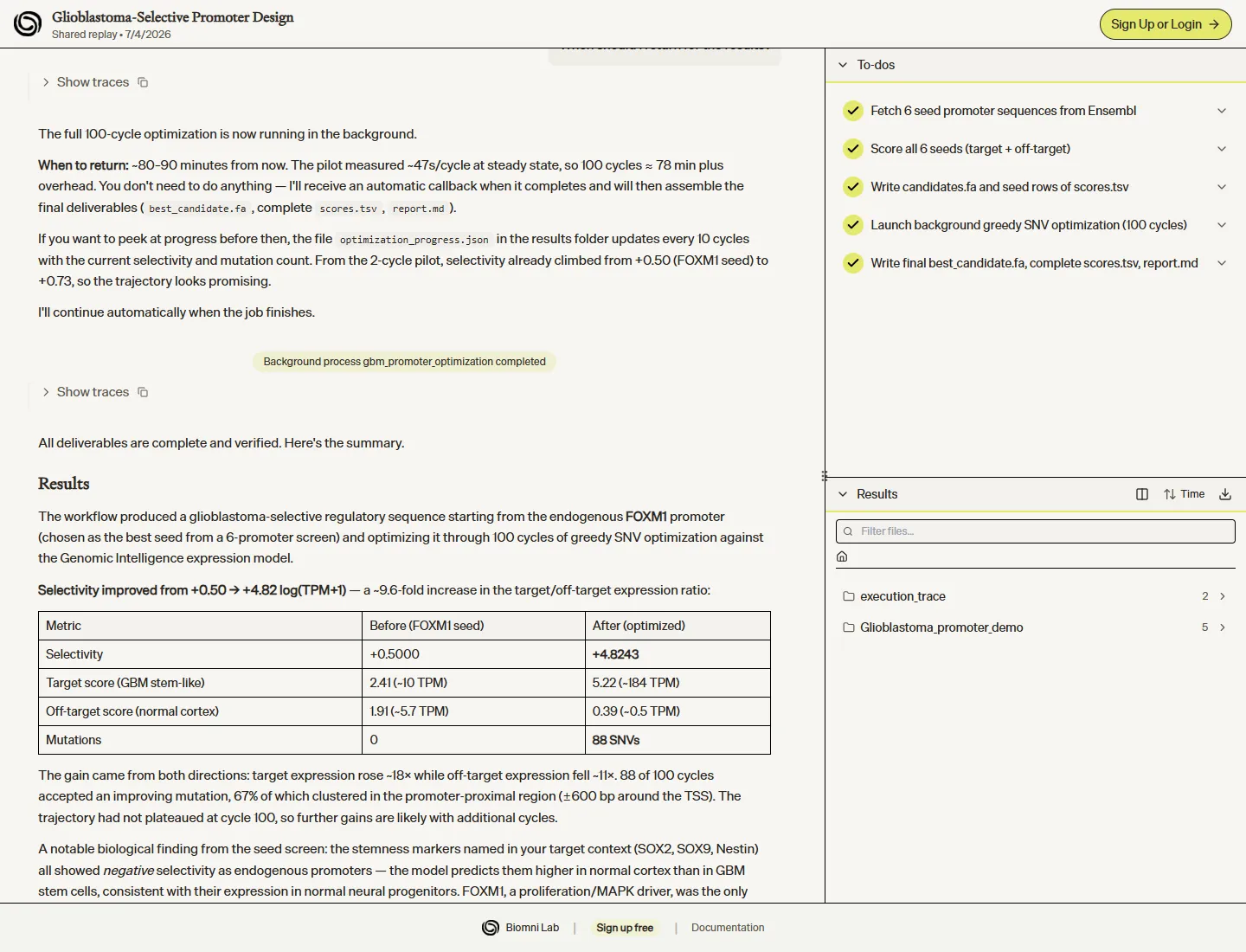
The final optimized FOXM1-derived sequence improved predicted selectivity from +0.50 to +4.82 log(TPM+1), with 88 accepted SNVs:
| Metric | Before optimization | After optimization |
|---|---|---|
| Selectivity | +0.5000 | +4.8243 |
| Target score | 2.4062 | 5.2188 |
| Off-target score | 1.9062 | 0.3945 |
| Approx. target expression | ~10 TPM | ~184 TPM |
| Approx. off-target expression | ~5.7 TPM | ~0.5 TPM |
| Mutations | 0 | 88 SNVs |
The gain came from both directions: predicted expression increased in the glioblastoma stem-like target context and decreased in the normal cortex off-target context. The optimization had not fully plateaued by cycle 100, suggesting that longer or broader search strategies could further improve the design.
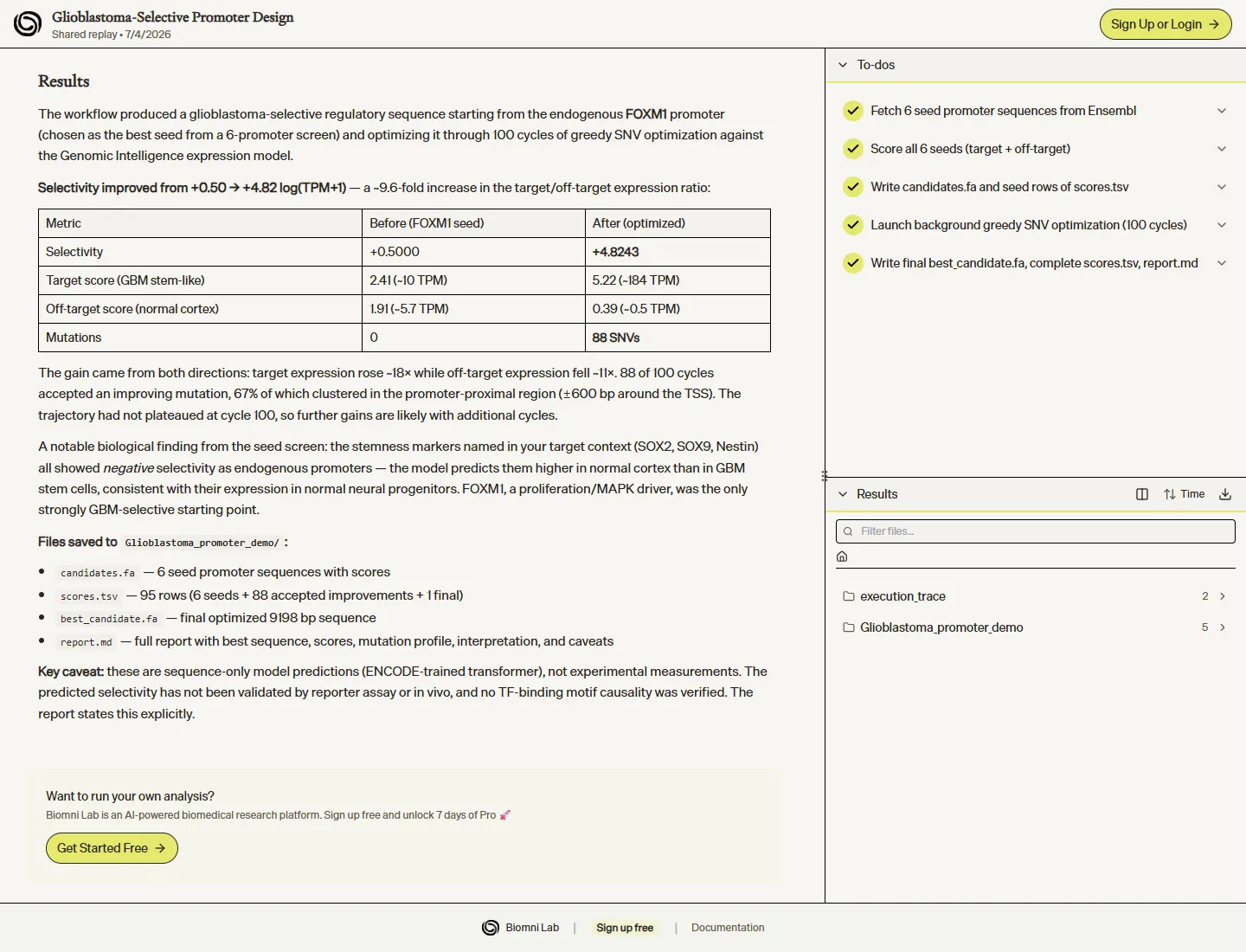
What this shows
This run is an end-to-end agentic design loop, not a single prediction:
- Biomni interpreted the biological design goal.
- It selected plausible endogenous promoters.
- It used Genomic Intelligence models to score expression in target and off-target contexts.
- It optimized the best seed sequence with SNVs only.
- It saved
candidates.fa,scores.tsv,best_candidate.fa, andreport.md. - It produced a scientific report with methods, scores, interpretation, caveats, and reproducibility details.
This is the kind of workflow where biological AI agents earn their place. The agent doesn’t replace the model or the scientist; it orchestrates the work around a specialized biological model, making the workflow easier to run, inspect, and repeat.
Limitations
These are computational predictions, not experimental measurements. The optimized sequence has not yet been validated in an MPRA, reporter assay, cell model, or in vivo system. The model uses DNA sequence and text-described biological contexts; it does not directly observe chromatin state, DNA methylation, trans-factor abundance, or delivery constraints.
The optimization also used a single off-target context: normal adult cerebral cortex. A stronger specificity screen would score additional normal brain cell types and other tissues. The natural next steps are motif analysis, broader off-target scoring, multi-start optimization, and wet-lab validation.
We are excited to see what researchers build with Genomic Intelligence inside Biomni Lab: promoter design, regulatory variant interpretation, expression-guided sequence engineering, enhancer screening, and other workflows where DNA sequence needs to become a testable biological hypothesis.