The genome is the largest dataset on Earth
The case for DNA as AI’s next frontier — why genomic data now dwarfs the internet, why text-style scaling has failed on it, and what reading the full genetic program could unlock.
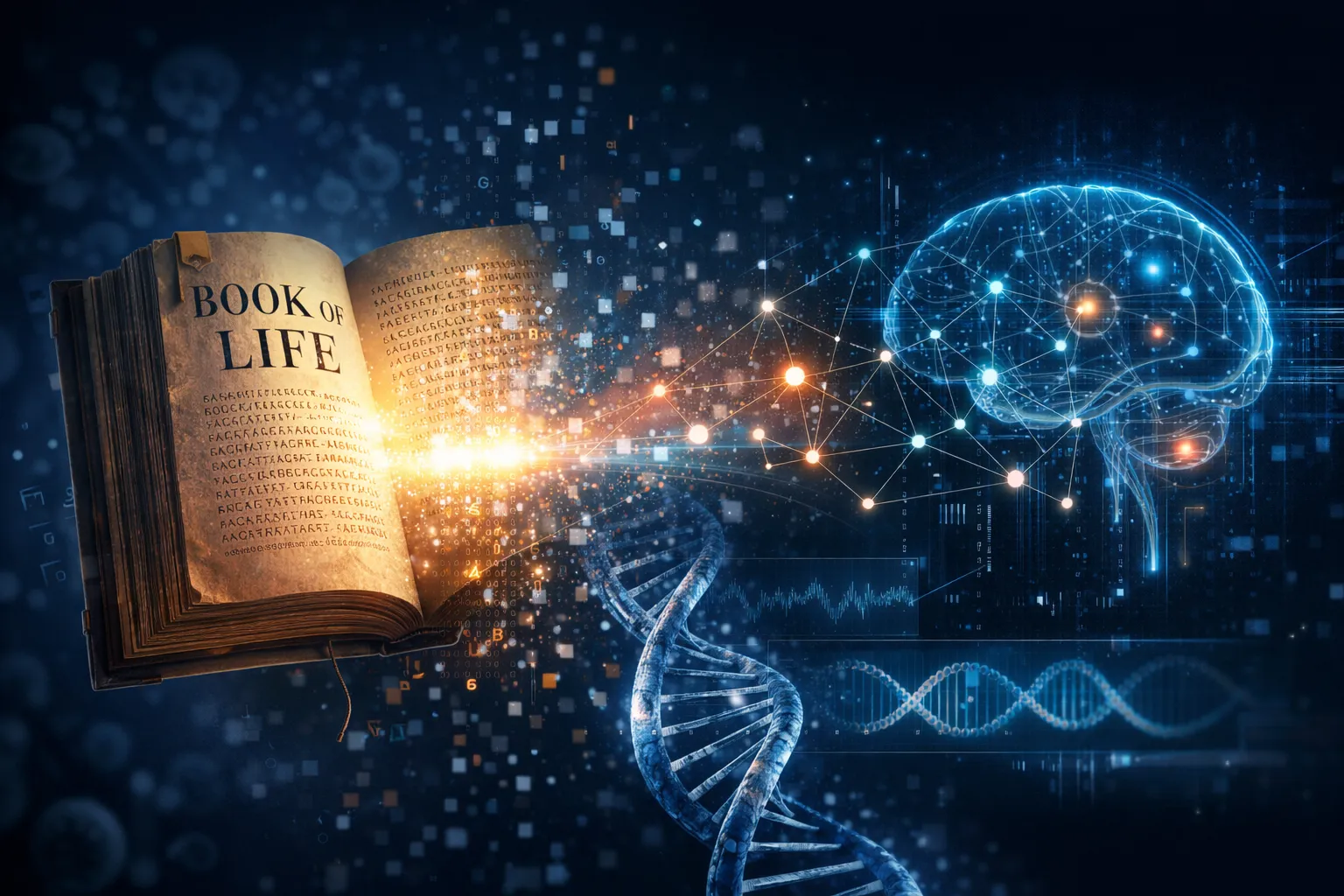
Ten years ago, I believed the next big thing in AI would be natural language — machines that could read and write like humans. I was right. Now I’m making another bet: the next frontier isn’t language. It’s DNA, which is the language of life.
Here’s why: we’ve spent decades sequencing genomes and we’re extraordinarily good at it now. The cost of sequencing a human genome has dropped faster than Moore’s Law. DNA data is already larger than the entire internet, and it doubles every 18 months. Within a few years, we will have five times more genomic data than all the text ever written by humanity.
We have more data than we know what to do with. And that’s exactly the problem. All that data sits largely uninterpreted. We can read the letters. We cannot read the meaning.
The genome is a program. We haven’t learned the language yet. Every cell in your body contains roughly 6 billion DNA letters, a program that builds and runs a human being. Identical twins are the clearest proof of how precise this program is: the same code produces nearly identical people.
Can AI learn to read this specification?
The answer is yes, but not in the way we expected.
When we first applied LLM-style transfer learning to DNA sequences, the results were exciting. Train on genomic sequences, fine-tune on a specific task, predicting gene regulatory elements, for example, and the models work remarkably well. They even generalise across species. A model trained on human data can still identify parts of genes in other mammals. The language of life has universal grammar.
But then we hit a wall.
We scaled the models up, 1–7–40 billion parameters, and performance barely moved. The scaling laws that drove rapid progress in natural language don’t translate to genomes in the same way.
Why? Because DNA isn’t like text. DNA does not behave like language at all. Imagine a book where words are not separated by spaces, where meanings overlap, and where the same sequence can carry different interpretations depending on context. Large portions of the text can change with limited effect, yet a single mutation in the right place can alter the entire outcome.
This creates two fundamental challenges for AI. First, genomic information is distributed extremely unevenly. Much of the sequence is repetitive or redundant, while the truly meaningful signals may be rare, subtle, and easy to miss. A good genome model cannot simply learn the most common patterns. It has to distinguish biological signal from repetitive noise, and it has to do so in a way that reflects how evolution actually works: preserving what matters, tolerating what does not, and amplifying rare changes that have real functional consequences.
Second, long-range interactions. In text, most dependencies are local. In the genome, regulatory logic can span hundreds of thousands or even millions of base pairs. Elements controlling gene expression may sit far away from the genes themselves. Most current models are optimized for short-range pattern recognition. They still process the genome in small windows, even when the biology depends on global context.
Solving this will require rethinking how we build models for biology.
It is not enough to scale architectures designed for text. Genome models must learn to distinguish meaningful biological signal from repetitive background in a way that reflects how evolution actually works. Not just what is frequent, but what is conserved, functionally constrained, and unexpectedly important.
At the same time, they must operate across long ranges. Biological regulation is not local. The relevant information is often distributed across vast regions of the genome, and understanding it requires integrating signals across that full span.
This is not just a scaling problem. It is an architectural one.
What becomes possible when you can read the whole program? Predicting disease risk beyond the limits of current polygenic scores. Designing gene therapies in silico instead of through repeated wet-lab iteration. Understanding why certain DNA sequences are critical for organ function while others matter only at the cellular level, and identifying the connections between them.
And perhaps most profoundly, answering some of biology’s oldest questions by learning from the experiments evolution has already run. Can we uncover the genomic determinants of the most consequential human phenotypes, such as longevity? Different species age at dramatically different rates and live for radically different lengths of time. That diversity suggests that biology contains multiple solutions.
If we can learn which sequence features causally drive those differences, we gain a new way to search for intervention points in the human genome, places where changing regulation, repair, or cellular maintenance might extend healthy lifespan. This is not about building another language model. It is about building the foundations for understanding and designing biological systems at scale.
The language of life has been there all along. We are finally learning to read it.