Can We Design a Cancer Therapy for One Patient in Just Two Days?
What we learned at the South Park Commons Bio Hackathon about using genomic world models for personalized cancer therapy design.
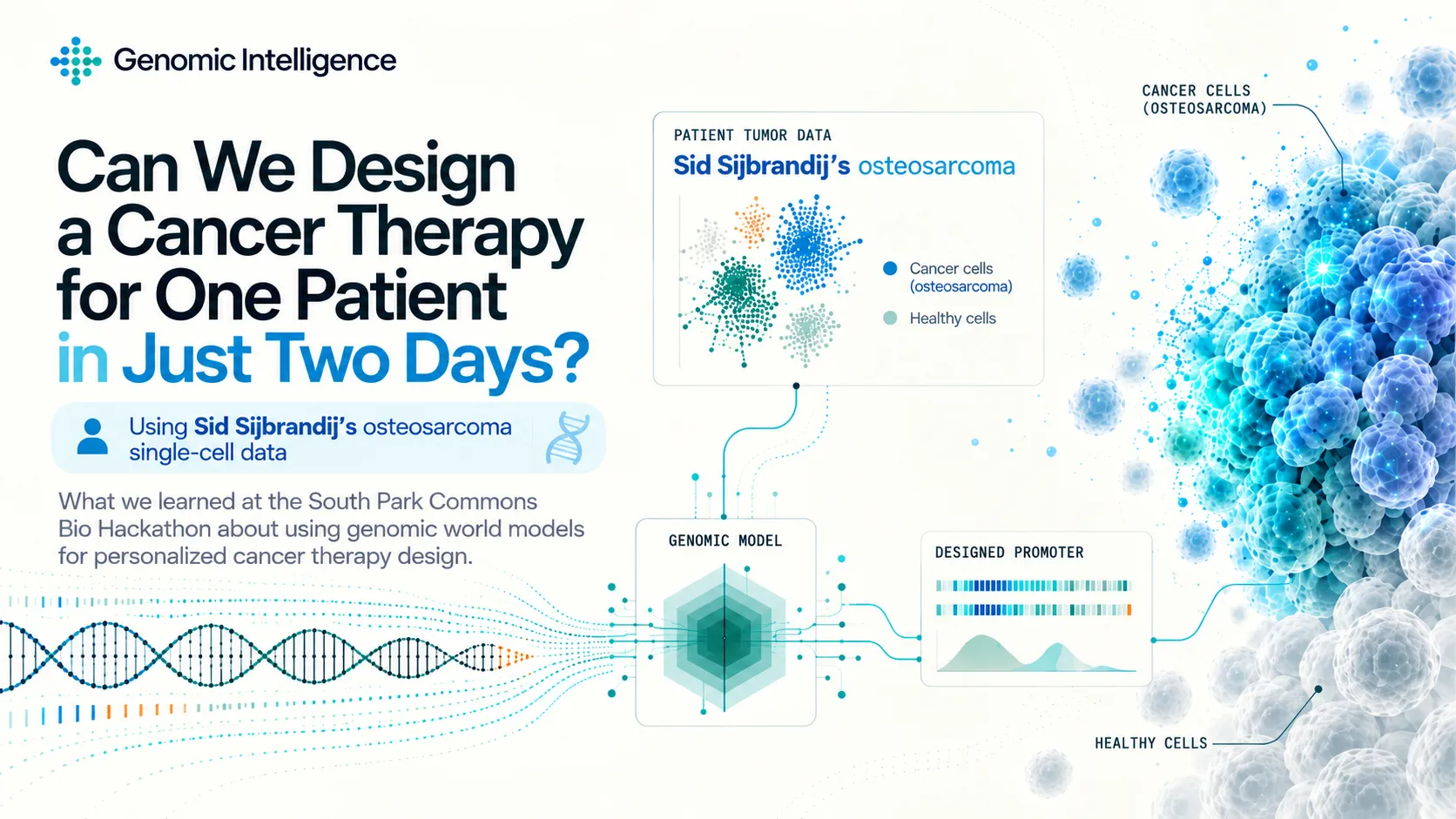
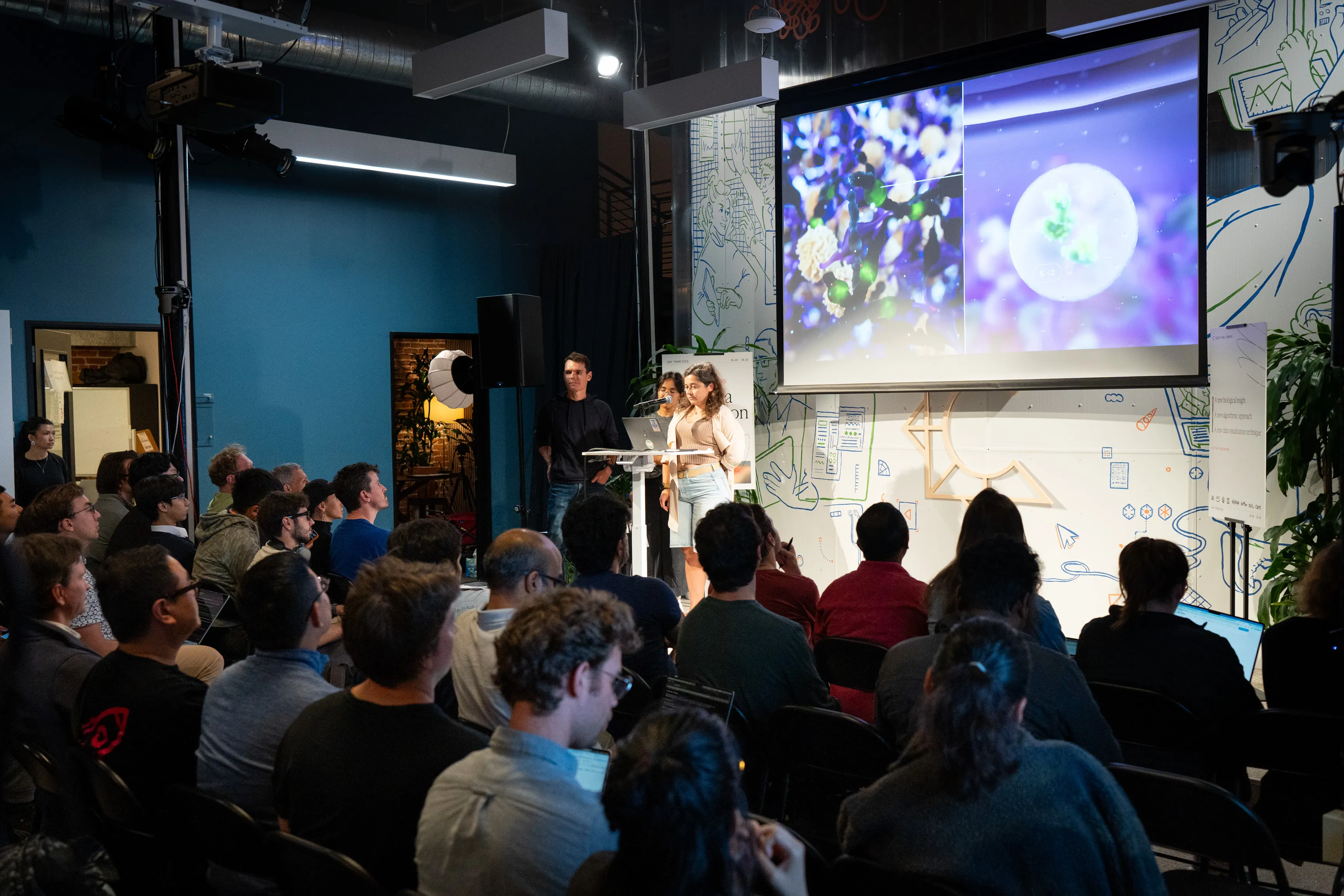
Last weekend, our Genomic Intelligence team participated in the South Park Commons Bio Hackathon in San Francisco. It was a great experience, and we were excited to make it to the list of finalists! We had two days, real patient data, and a question I have been thinking about for a long time: What if, instead of finding the right drug for a patient, we could design a therapy specifically for that patient?
We worked with data from Sid Sijbrandij‘s osteosarcoma tumor. Sid is the co-founder of GitLab, and his decision to share his cancer data with researchers is inspiring. His journey has also been a personal inspiration for me and part of what led me to start Genomic Intelligence. I want to help build a future where we can use a person’s biology to design treatments for them.
There is a long way to go before that becomes a reality. But the hackathon gave us an opportunity to explore one small piece of it: could we design regulatory DNA that would be more active in this patient’s cancer cells than in the nonmalignant cells around them?
Can we distinguish cancer cells from healthy cells?
One of the biggest challenges in cancer treatment is selectivity. We want to destroy cancer cells without damaging healthy tissue, but cancer cells share almost all their DNA with normal cells. Part of what makes them different is how that DNA is used: which genes are active, and how strongly they are expressed.
The dataset contained 12,877 cells, organized into 21 groups. Five groups represented malignant cells, while the remaining sixteen represented cells from adjacent nonmalignant tissue. This allowed us to study differences between cancer and nonmalignant cells within the same patient’s tumor environment.
Our goal was to design a promoter, a regulatory DNA sequence that helps control when and how strongly a gene is expressed. We wanted it to be highly active in malignant cells and much less active in the nonmalignant cells represented in the dataset.
Promoters are interesting for therapy development because they can help control where therapeutic genes become active. In an engineered oncolytic virus, for example, a promoter could potentially help restrict the expression of essential viral functions to cancer cells. We wanted to see whether we could design such sequences around the biology of one patient’s tumor.
From predicting gene expression to designing DNA
At Genomic Intelligence, we develop genomic world models that learn relationships between DNA sequences, cellular context, and biological function. Our Gene Expression Prediction model takes a DNA sequence and information about its biological context, such as a cell type or tissue, and predicts gene expression.
For this experiment, we used those predictions to guide design. We first fine-tuned the model on the patient’s single-cell data to make it more sensitive to the cellular contexts represented in the tumor. We then evaluated candidate regulatory sequences, looking for promoters that would maximize predicted expression in malignant cells while minimizing expression in nonmalignant cells.
What I find exciting here is the possibility of designing new regulatory DNA around molecular information from an individual patient. A model that predicts how a sequence might behave can also help us search for sequences with the behavior we want. That gives us a way to connect patient data to a concrete design objective.
What did we find?
Our best candidate achieved approximately 3:1 predicted tumor-to-healthy promoter activity. The model predicted that the sequence would be about three times more active in malignant cells than in the adjacent nonmalignant cells represented in this dataset.
The computational experiment took approximately six hours, with around $20 in GPU compute costs. We could do this because we started with an existing genomic foundation model. That estimate covers this experiment only. It does not include generating the sequencing data, pretraining the model, or experimental validation.
There is also an important limit to what we can conclude: these are computational predictions. We have not yet shown that the promoter has the same selectivity experimentally. We do not know whether a threefold difference would be sufficient for a particular therapeutic application, or how the sequence would behave in tissues outside this dataset. The nonmalignant cells around a tumor cannot tell us everything we need to know about safety elsewhere in the body.
Still, I find the result encouraging. Within a two-day hackathon, we took real data from one patient, adapted our model, and used it to design regulatory DNA candidates with a specific objective. The next question is whether those predictions hold up in the lab.
Could this help us program viruses to fight cancer?
One application we are interested in is oncolytic viral therapy. Oncolytic viruses can be engineered to replicate in cancer cells, destroy them, and potentially stimulate an immune response against the tumor. Controlling their activity in healthy tissues remains a central challenge.
If we can design promoters with reliable selectivity, they may eventually help control essential viral functions or the expression of therapeutic genes. Tumors can differ substantially between patients, even with the same diagnosis. Could we design regulatory sequences around those differences, using molecular data from each person’s tumor?
We are already exploring a related direction with Julia Davydova’s laboratory at the University of Minnesota, working on regulatory DNA design for oncolytic virus development, initially focusing on pancreatic cancer. The hackathon let us explore how the same general approach could be adapted to an individual patient with osteosarcoma.
There are many questions to work through, from whether the predicted selectivity survives experimental testing to how a promoter behaves inside a therapeutic construct. These are the questions we want to investigate with experimental collaborators.
What comes next?
Our immediate next step is wet-lab validation. We want to test the designed promoters in tumor and healthy cells, measure how robust the selectivity is, and investigate whether the approach generalizes across patients and cancer types. Testing activity in other relevant tissues will matter just as much as measuring activity in the tumor.
I also find the economics interesting. Six hours of computation and $20 in GPU costs certainly do not mean we can develop a cancer therapy for $20. Validation, delivery, manufacturing, and clinical development remain expensive and time-consuming. But making initial designs faster and cheaper could help us explore more possibilities, especially for smaller patient populations.
What motivates me most is the possibility of changing what personalized medicine can mean. Today, we often use a patient’s biological information to choose among existing treatments. I would love to see us get to a point where we can use that information to design the treatment itself. This experiment is a very early step, with a lot still to validate, but it was exciting to see how much we could explore in two days.

A big thank you to South Park Commons for organizing the hackathon, to Sid Sijbrandij for sharing his data with the research community, and to Alex Boldakov for working with me on this experiment. I really enjoyed meeting so many people exploring AI in biology, and making it to the finals was a wonderful bonus!
I would love to hear from researchers working on cancer biology, oncolytic viruses, and personalized therapeutics. What do you see as the biggest challenges in making patient-specific therapeutic design practical?