Designing the Control Layer of Gene Therapy: Introducing Promoter Atlas
From a biological specification to ready-to-test promoter sequences using computation for the broad search and experiments for focused validation.
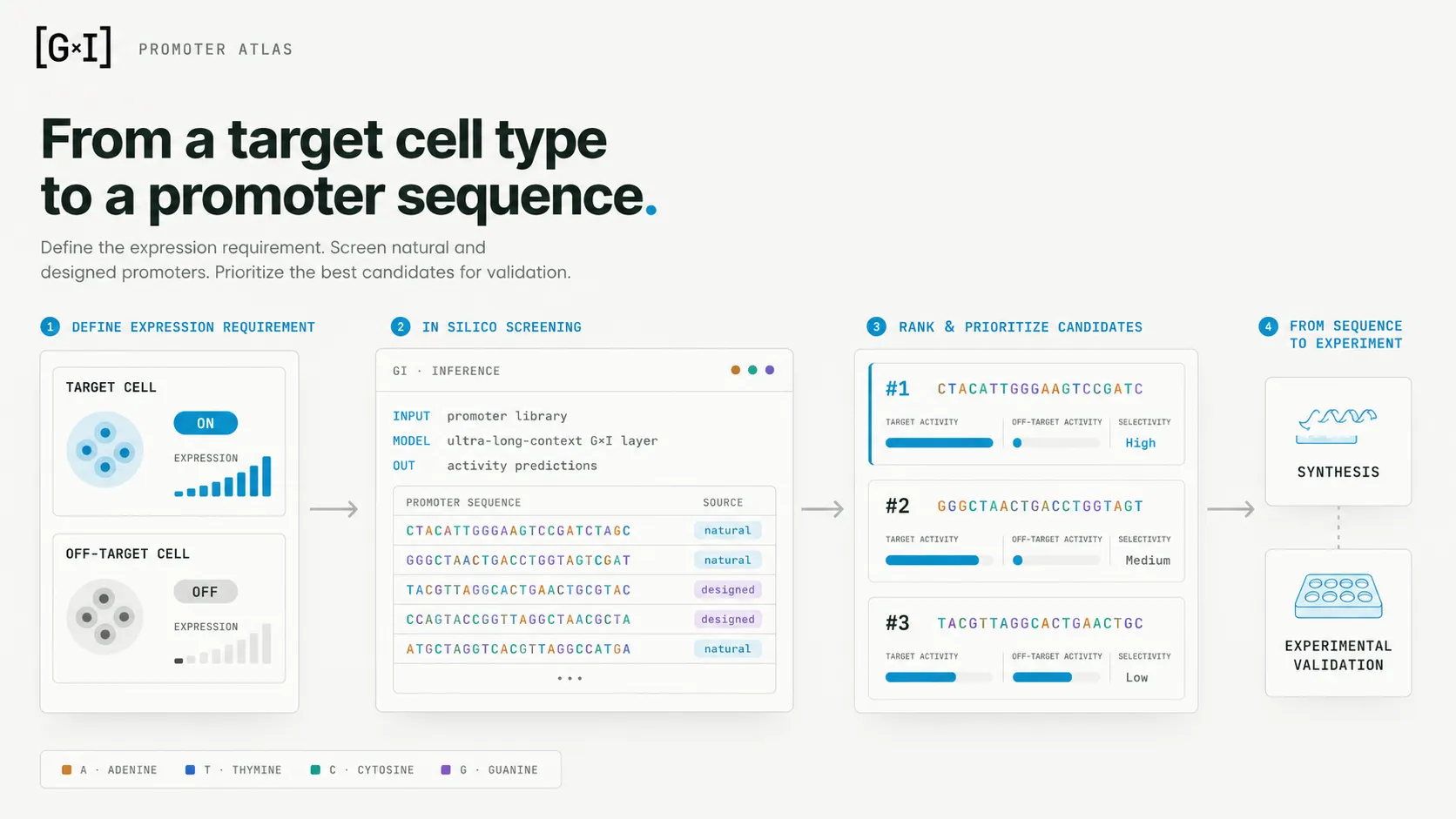
The future of genetic medicine will be designed
Gene therapies are still developed through repeated cycles of biological trial and error. A team selects a regulatory sequence, builds a construct, produces a vector, tests it, analyzes the result, and starts again when expression is too weak, too strong, or active in the wrong cells.
We believe the future looks different: therapeutic DNA will increasingly be designed computationally against a biological specification, synthesized on demand, and validated experimentally.
Promoter Atlas is a Genomic Intelligence product built for that future. A researcher specifies where a therapeutic gene should be active, where it should remain silent, and the desired expression range. Genomic Intelligence evaluates natural and designed regulatory sequences and returns promoter candidates ready for synthesis and laboratory testing.
The laboratory remains essential. Its role should be to validate the strongest candidates instead of searching blindly through sequence space.
From a hackathon prototype to a product
Promoter Atlas began at re:AGENT 2026, a bio + AI hackathon where we tested a practical question:
Could our model translate a gene-therapy requirement into promoter sequences ready for experimental evaluation? Specifically, could it activate a therapeutic gene in one cell type while keeping it quiet in another?
Our prototype developed during the hackathon compared natural human promoters across target and off-target cell types and proposed designed sequences when existing promoters were not selective enough. More importantly, it revealed a product opportunity: move the broad promoter search into software, then use the laboratory for focused validation.
We developed that workflow into Genomic Intelligence Promoter Atlas. Researchers can compare predicted expression profiles, select a candidate, export its sequence, and order it for synthesis.
Why promoters matter
A gene therapy is more than its therapeutic gene. The therapeutic gene determines what a treated cell can produce. The promoter determines where, when, and how much of that product is produced.
A useful promoter must solve three problems at once:
- Produce enough of the therapeutic product in target cells
- Avoid excessive expression that could itself become toxic
- Keep the therapeutic gene inactive in cells and tissues where it could cause side effects
Promoter choice does not replace capsid engineering, dose optimization, biodistribution studies, or immune management. It is, however, a central control layer built directly into the therapeutic cassette. FDA guidance highlights tissue-specific promoters as one way to control expression in target cells and limit activity in non-target tissues, and it emphasizes evaluating transgene expression in both target and non-target tissues during preclinical development.
The objective is not maximum activity. It is the right amount of therapeutic product in the right cells.
Gene activity control is part of the drug
The consequences of poor regulatory control are not theoretical. In early trials for X-linked severe combined immunodeficiency, strong regulatory elements in integrating retroviral vectors activated genes near the integration site. Five of 20 treated children developed T-cell leukemia, and one died. This was not an AAV promoter-specific failure, but it established an enduring lesson: regulatory DNA is part of the safety system, not a neutral accessory.
Excessive expression can also turn efficacy into toxicity. In a ten-patient trial of the hemophilia B gene therapy FLT180a, one high-dose participant reached factor IX activity of 260% of normal after four weeks and required months of anticoagulation. The lesson is not that one promoter explains every adverse outcome; dose, delivery, vector biology, immunity, and patient factors all matter. The lesson is that expression level is a design variable that must be controlled.
A promoter that is too broad, too strong, or too weak can undermine an otherwise promising therapeutic program. This is why Promoter Atlas treats target-cell activity, off-target activity, and expression range as joint design objectives.
Today, the laboratory is often used as the search engine
Promoter development commonly begins with literature review and a small set of familiar sequences. If the first candidates are too weak, too strong, or insufficiently specific, the team repeats synthesis, cloning, vector production, cell assays, and analysis.
Animal studies may then reveal that a sequence behaving well in vitro performs differently in vivo. Differences between preclinical models and human biology add another layer of translation risk.
Under our current planning assumptions, conventional promoter development may require three to five Design-Build-Test-Learn cycles. Each cycle may take roughly eight to ten weeks and cost about $0.5–1.5 million in direct R&D. Reaching a lead cassette could therefore require seven to twelve months and approximately $2–7 million. These figures are illustrative, not industry benchmarks, and will vary materially by program.
Promoter Atlas moves the broad search into software
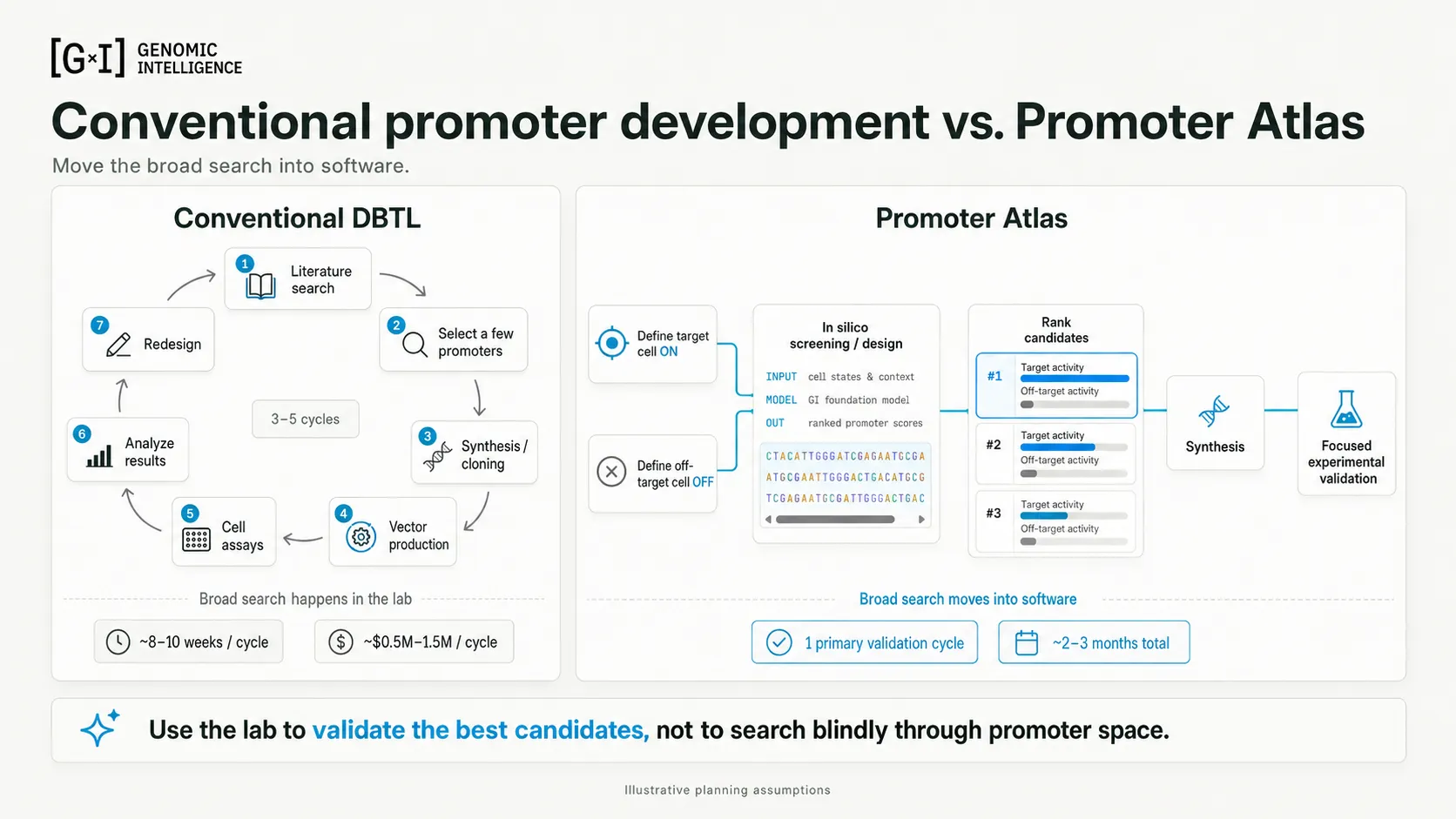
Instead of experimentally screening a small number of sequences and repeatedly returning to the drawing board, our models evaluate thousands of natural and designed promoters before synthesis. The research team enters the laboratory with a focused set of candidates prioritized for the required expression profile.
The aim is to concentrate experimental work into one primary validation cycle. Under the same illustrative assumptions, that could mean approximately two to three months and $0.5–1.5 million to reach a lead candidate. Actual performance will depend on the target, vector, assay system, and quality of the biological data.
This is not a promise to replace experimental validation. It is a way to make each experiment more informative and reduce avoidable cycles.
What researchers receive
Our genomic models are the design engine. The immediate product is a DNA sequence that a research team can test. Each Promoter Atlas entry includes:
- The complete promoter sequence
- The intended target and off-target cell types
- Predicted expression in each biological context
- Predicted target-versus-off-target selectivity
- Whether the sequence is natural or designed
- Automated synthesis and sequence-composition checks
- Downloadable files for downstream construct design
The selected promoter can be inserted into an AAV transfer plasmid, lentiviral construct, conventional plasmid, or another expression vector next to the customer’s therapeutic gene.
The workflow is direct: define the target cell, identify cells where expression must remain off, compare candidates, export a sequence, order synthesis, insert it into the therapeutic cassette, and validate it experimentally.
How the platform becomes defensible
The platform creates a lab-in-the-loop: with customer permission and appropriate agreements, every tested sequence improves the next design. It also connects laboratories through shared learning. A hypercholesterolemia program seeking liver activity but silence in the pancreas and a diabetes program seeking the opposite profile generate complementary evidence, even when developed independently. Over time, these otherwise isolated experiments become one expanding, proprietary sequence-performance dataset advancing each customer’s program while improving future ranking and design across the platform.
Promoter Atlas is the beginning
Today, Promoter Atlas helps researchers move from a target cell type to ready-to-test promoter candidates. The next step is to learn continuously from experimental validation, expand coverage across biological contexts, and design additional regulatory elements.
The longer-term goal is a system that translates a therapeutic specification into a complete, optimized expression cassette: genetic medicines designed computationally, manufactured on demand, and validated through focused experiments.
Researchers can browse prepared promoters, compare predicted expression profiles, inspect natural and designed candidates, export a selected sequence, and move directly toward synthesis and validation.
Design a promoter for your program
Explore Promoter Atlas, compare candidates, or contact us about a private design program.