Could your genome affect your response to Ozempic? Genomic Intelligence helps you explore it
A Nature GWAS study found a GLP1R variant linked to greater weight loss. Genomic Intelligence models suggest a second mechanism, help profile rare variants missed by GWAS, and let anyone screen their own genome.
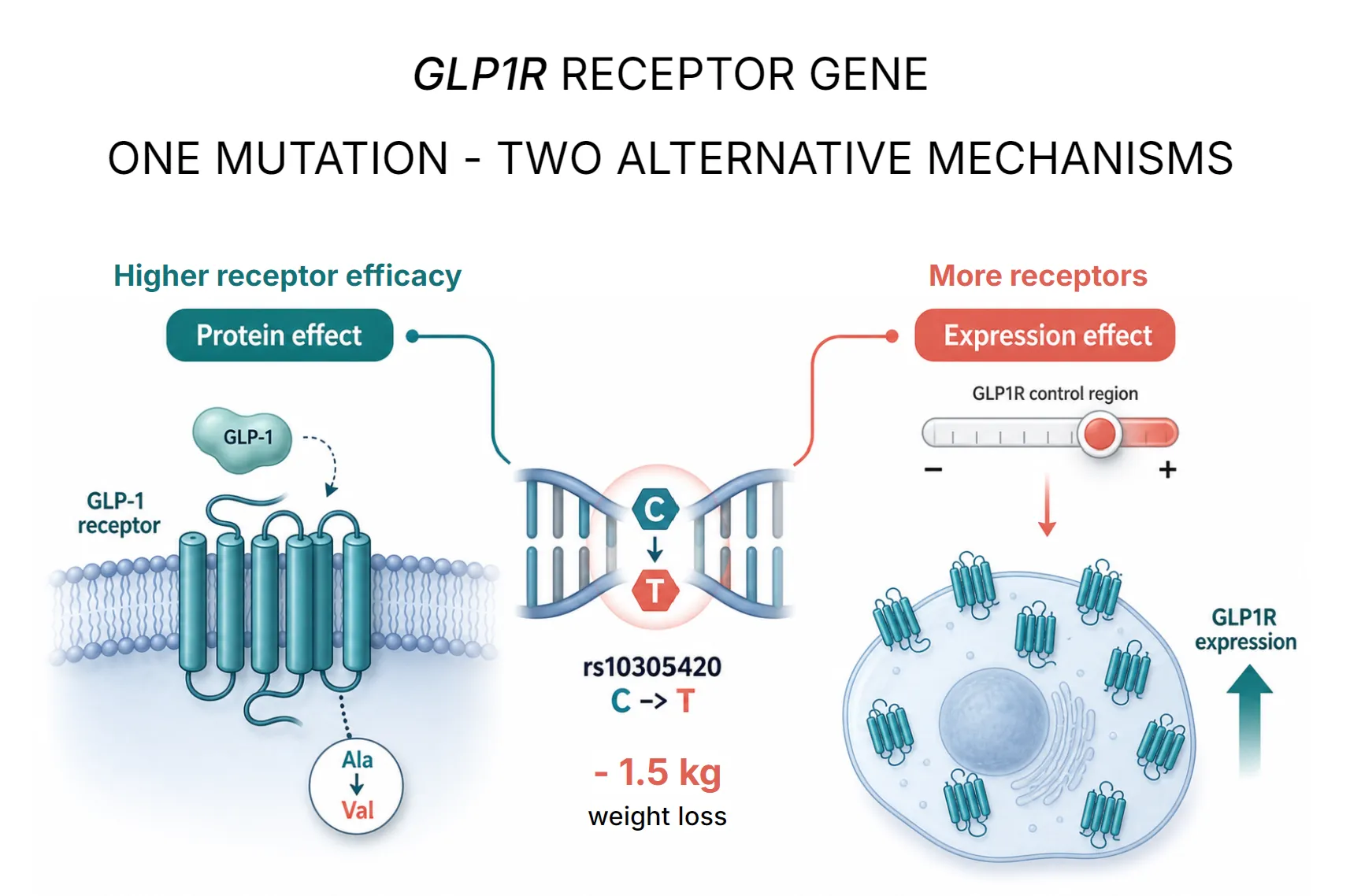
rs10305420 changes a single DNA letter in GLP1R gene. That tiny difference may influence treatment response in two ways: by altering the receptor protein and by changing how much GLP1R cells produce.Why do some people lose more weight on medications such as Ozempic than others?
Part of the answer may be written in their DNA.
That possibility reflects one of the central promises of modern genomics: that small differences in our genomes may help explain why the same treatment can produce different results in different people. Yet the variants uncovered by large genetic studies are often only the beginning. They point to a location in the genome, but not always to the biological story unfolding there.
A recent Nature paper, Genetic predictors of GLP1 receptor agonist weight loss and side effects, analyzed 27,885 people treated with GLP-1 drugs, including Ozempic, Wegovy, compounded semaglutide, Mounjaro, Zepbound, and compounded tirzepatide.
The strongest genetic signal associated with weight-loss response appeared in GLP1R, the gene that encodes the GLP-1 receptor. The variant, rs10305420, changes a single DNA base from C to T.
The T allele is common, occurring at a frequency of about 30% among people of European ancestry. On average, participants carrying it lost about 0.76 kilograms more weight per copy — roughly 1.5 kilograms for people who inherited the T allele from both parents. The statistical association was exceptionally strong (P = 2.9 × 10⁻¹⁰).
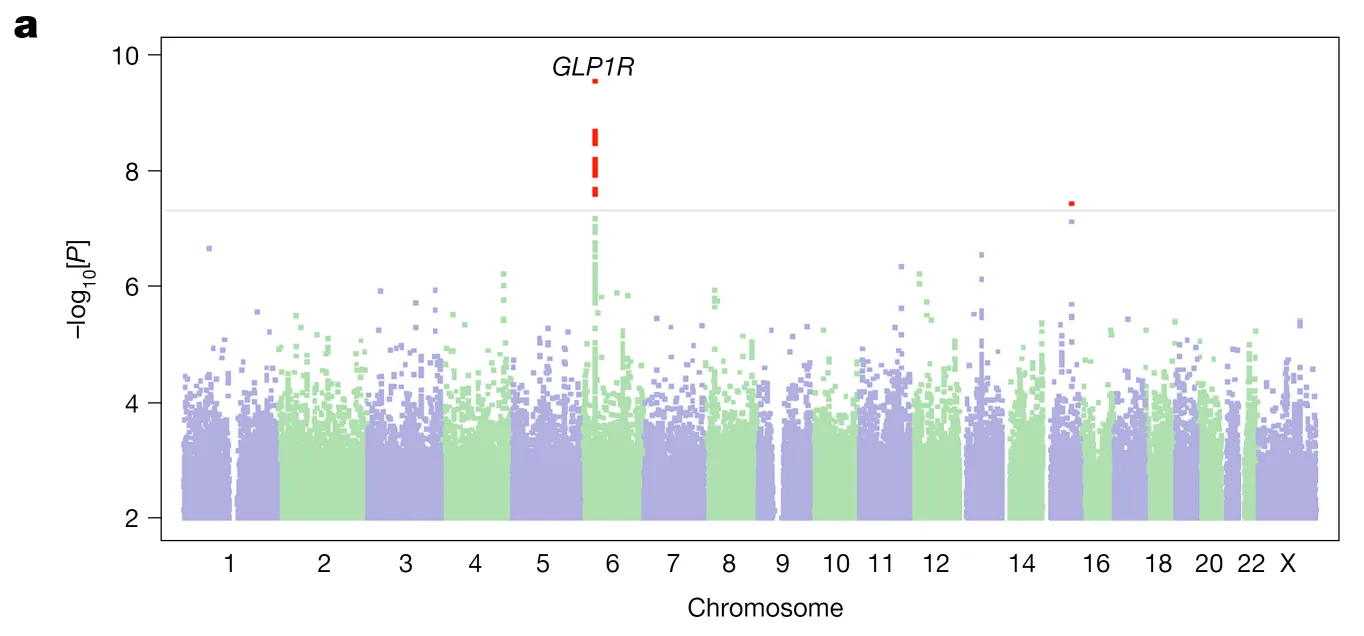
The figure is licensed under CC BY-NC-ND 4.0.
The study offers one plausible explanation for the association. The variant changes a single amino acid in the GLP-1 protein, potentially altering how the receptor functions.
But DNA rarely tells its story in only one way.
A variant that changes a protein can also influence when, where, or how strongly a gene is expressed. Because rs10305420 lies in a region involved in regulating GLP1R, we tested another hypothesis:
Could it change not only the receptor itself, but also how much of the receptor the body produces?
We explored this alternative mechanism with Genomic Intelligence ([G×I]) models in Claude Science and Biomni. The result supports expression mechanism.
![Bar chart titled ‘[G×I] Predicted GLP1R Expression’, plotting relative GLP1R expression against rs10305420 genotype: CC at 1.000, CT at 1.089 annotated -0.76 kg weight loss, and TT at 1.178 annotated -1.5 kg weight loss.](/_astro/GI-prediction.uBm_V4RW_Z1Qiavl.webp)
[G×I] expression model predicts positive effect of rs10305420 variant on expression of GLP1R.The [G×I] expression model predicts that the T allele of rs10305420 increases GLP1R expression in pancreas-associated tissues. If that prediction is correct, the variant may influence treatment response in two ways at once: by changing the receptor’s amino-acid sequence and by changing how much of the receptor is produced. That possibility now becomes a call for an experiment to be done.
Looking beyond the variants found by GWAS
The method used in the published research, GWAS, is powerful, but it works best for variants that are common enough to be detected many times in a study. Rare variants usually escape detection because there are too few carriers to produce a statistically significant signal—even when a variant may have a strong biological effect.
This is where [G×I] models can help. Instead of requiring thousands of people carrying the same variant, the models estimate its effect directly from the DNA sequence.
We used [G×I] models to screen variants near the GLP1R control region and found hundreds of candidates potentially affecting up to 527 million people worldwide. Now, we are working on the report for this study to be published soon - stay tuned!
Try it on your own variants
Building on the common variant highlighted in the Nature paper, we developed a workflow that can screen an individual genome and generate a personal, testable hypothesis about a possible contributor to GLP-1 treatment response.
You can run the same analysis on your own genome. We packaged the complete workflow as a portable agent skill: download it here.
1. Prepare your files
Create a new folder and place the downloaded SKILL.md file inside it. Add one of the following:
- a VCF file containing your variants;
- a table listing chromosome, position, reference allele, and alternative allele;
- or your FASTQ files if you only have raw sequencing data.
- any other genomic data provided by your sequencing service
If your agent does not support folders, simply upload SKILL.md and your genomic files together in the same conversation.
2. Open the files in an agent
Open the folder in Codex/Claude, or upload the files to Claude, Biomni, or another compatible agent. Make sure the agent has access to Genomic Intelligence models, for example through the [G×I] MCP server. Be careful when providing personalized genomic data, and only share it with systems you trust and understand.
3. Give the agent this prompt
Read
SKILL.mdand follow the workflow described there. Analyze my genomic file for variants near the GLP1R control region that may affect GLP1R expression. Use the genome assembly specified in my file; if it is not specified, ask me before continuing. Score the variants in pancreas-related contexts with the Genomic Intelligence expression model and compare their predicted effects withrs10305420.Report which variants are present in my genome, whether each is predicted to increase or decrease GLP1R expression, and whether it acts in the same or opposite direction as the efficacy-associated allele. Summarize the result in plain language and include a table with the variant, genotype, predicted effect, comparison with
rs10305420, and important limitations. Do not make treatment or dosing recommendations.
The agent will:
- find variants near the GLP1R control region;
- predict whether each variant increases or decreases GLP1R expression;
- compare their predicted effects with
rs10305420; - show which variants may shift GLP1R activity in the same direction as the efficacy-associated allele, and which may shift it in the opposite direction.
The result is a personalized, model-based hypothesis about how your GLP1R variants may contribute to medication response. It is not a clinical prediction and does not tell you which medication to take or how much weight you will lose.
Disclaimer: This is exploratory research output, not a medical test. It should not be used to choose, dose, start, stop, or rank medications. Only share genomic data with systems you trust.