Predicting gene expression and optimizing promoters with ClawBio and Genomic Intelligence
A step-by-step walkthrough of the gi-expression skill run through ClawBio and Codex: predict HBB promoter activity in K562 and HepG2, then greedily mutate the promoter to raise predicted HepG2 expression from 0.76 to 390 TPM.
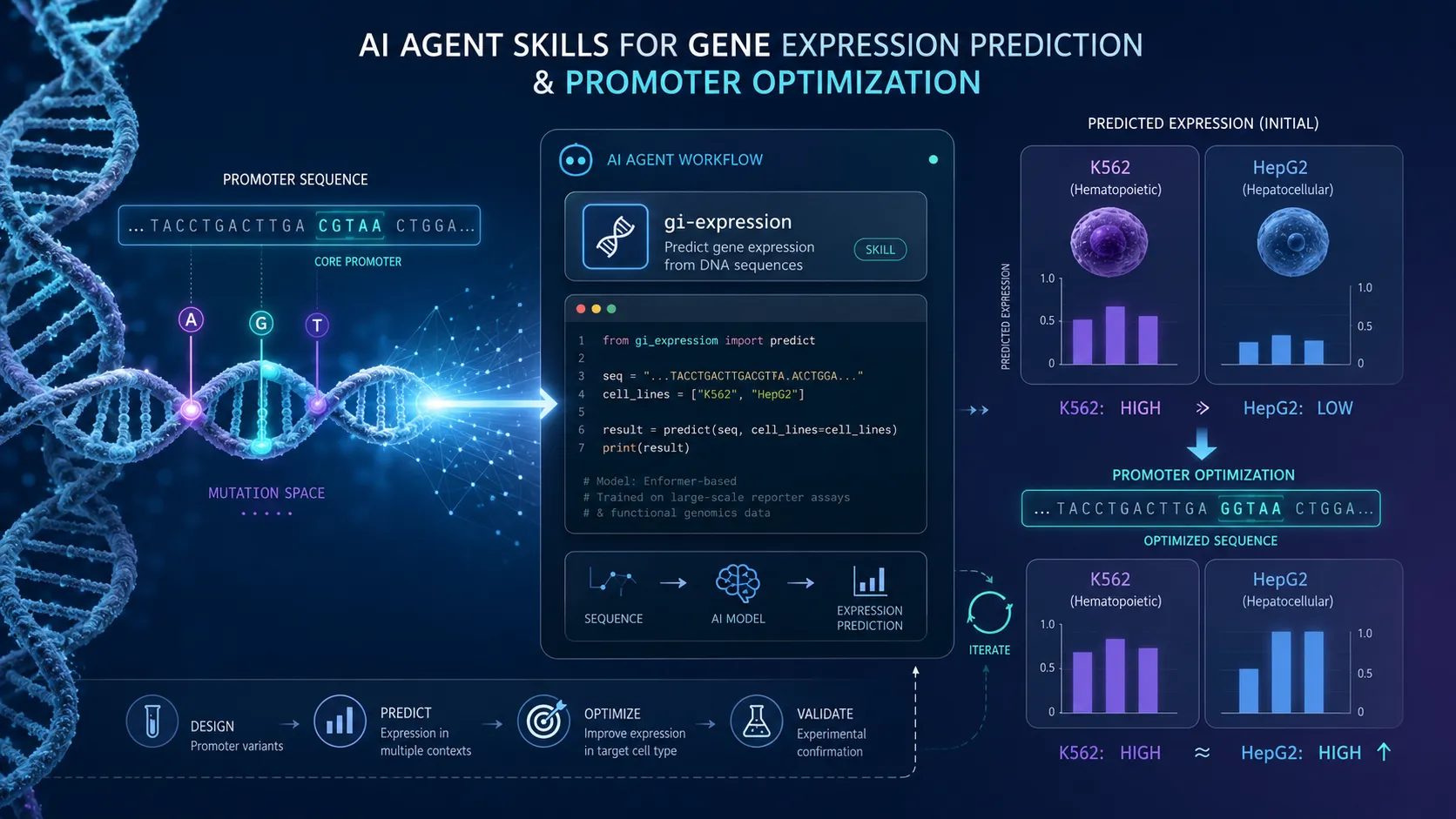
TL;DR
ClawBio lets you run biology-focused AI workflows as Codex or Claude skills. In
this walkthrough, we use the gi-expression skill from Genomic Intelligence with
Codex to predict gene activity in different cell types and design promoter
variants with improved predicted expression.
Introduction
What is ClawBio?
ClawBio is a collection of biology-oriented skills for AI coding agents such as Codex. Each skill is a self-contained workflow with instructions, code, examples, and reproducibility support.
Instead of asking Codex to invent a bioinformatics pipeline from scratch, you point it to a specific skill, such as:
skills/gi-expressionThe skill tells Codex what inputs are valid, what assumptions are allowed, how to call the model, and what outputs should be produced.
This is important because biological workflows are easy to get subtly wrong. For
example, the gi-expression skill requires the input FASTA file to be:
- single-record
- exactly 9,198 bp
- TSS-centered
- in gene-sense orientation
- accompanied by a detailed assay and biosample description
What is Genomic Intelligence?
Genomic Intelligence is a platform for sequence-to-function prediction. In this
example, we use its
gene expression model through
the ClawBio gi-expression skill.
The model takes two main inputs:
- A DNA sequence around a transcription start site, or promoter.
- A text description of the biological context, such as assay type, cell type, genome version, and RNA-seq metadata.
It returns predicted gene expression, reported as:
log(TPM+1)where TPM means Transcripts Per Million, a standard RNA-seq expression measure.
This makes it possible to ask questions like:
How active is this promoter in K562?
or:
Can we mutate this promoter to make it more active in HepG2?
What is a promoter and how does it regulate gene expression?
A promoter is a DNA region near the start of a gene that helps control when, where, and how strongly that gene is expressed.
You can think of it as a regulatory switch. The same gene may be highly active in one cell type and nearly silent in another because the promoter is interpreted differently depending on the cellular context.
For example, the hemoglobin beta gene, HBB, is associated with blood cells, so its promoter is expected to be more active in blood-related cells like K562 than in liver-derived cells like HepG2.
That is exactly what the model predicted:
K562:  2.8594 log(TPM+1) ≈ 16.45 TPM
HepG2: 0.5625 log(TPM+1) ≈ 0.76 TPM
The next step is more interesting: can we modify the promoter sequence so that it becomes more active in HepG2?
What we are going to do
We will run a small promoter-design workflow with Codex, ClawBio, and Genomic Intelligence.
The workflow has four stages:
- Set up ClawBio and the
gi-expressionskill. - Predict HBB promoter expression in K562.
- Re-run the same promoter in HepG2.
- In silico mutate the promoter to increase predicted HepG2 expression.
The optimization strategy is intentionally simple:
- Start with the reference HBB promoter sequence.
- Introduce one random single-nucleotide mutation.
- Predict HepG2 expression with the GI model.
- If expression improves, keep the mutation.
- Otherwise, discard it.
- Repeat.
Because the model requires exactly 9,198 bp, we use substitutions only, not insertions or deletions.
Walkthrough with prompts and what is returned at each step
Step 1. Open Codex and create a new project
I use Cursor IDE, where you simply open the main window and click the “Open Project” button. A project can be any folder on your PC. Then, I open Codex from plugins, sign in to my account, and continue working in chat mode. No coding is required.
Step 2. Ask Codex to use the ClawBio skill
Prompt:
Use the ClawBio skill located at skills/gi-expression.

Task:
Predict gene expression for HBB promoter.

Description:
assay term name is polyA plus RNA-seq. description is PolyA RNA-Seq from oligo-dT primed Total RNA on the K562 cell line. biosample summary is Homo sapiens K562. life stage age is adult 53 years. perturbed is False. strand specificity is unstranded. genome annotation is V29. mapped run type is paired-ended. id is ENCFF578UUD. genome is GRCh38.

Requirements:
- Read skills/gi-expression/SKILL.md first.
- Follow the skill exactly.
- Check that the FASTA is single-record, 9,198 bp, TSS-centered, and in gene-sense orientation.
- Use GI_API_KEY from the environment.
- Save all outputs to results/gi-expression/.
- Do not improvise biological assumptions if required metadata is missing.
What Codex does:
- Reads SKILL.md
- Validates the FASTA
- Checks sequence length and orientation
- Calls the GI expression model
- Saves the output bundle
Returned result:
Prediction:
2.8594 log(TPM+1) ≈ 16.45 TPM
Saved files:
results/gi-expression/report.md
results/gi-expression/result.json
results/gi-expression/fasta_validation.md
results/gi-expression/reproducibility/command.sh
results/gi-expression/reproducibility/environment.json
You can validate these results by navigating to Genomic Intelligence and using the UI to reproduce this experiment. HBB and K562 are available among the examples.
Step 3. Predict the same promoter in HepG2
Prompt:
Now repeat the analysis for the same promoter region but using another cell type: HepG2.

Use this cell type description:

assay term name is polyA plus RNA-seq. description is RNA-seq on human HepG2 (paired-ended). biosample summary is Homo sapiens HepG2. life stage age is child 15 years. perturbed is False. strand specificity is forward. genome annotation is V29. mapped run type is single-ended. id is ENCFF588KDY. genome is GRCh38.
What Codex does:
- Reuses the same validated HBB promoter FASTA
- Changes only the biological context description
- Runs the GI expression model again
- Saves results separately
Returned result:
HepG2 prediction:
0.5625 log(TPM+1) ≈ 0.7551 TPM
Saved files:
results/gi-expression-hepg2/report.md
results/gi-expression-hepg2/result.json
results/gi-expression-hepg2/fasta_validation.md
results/gi-expression-hepg2/reproducibility/command.sh
results/gi-expression-hepg2/reproducibility/environment.json
Step 4. Optimize the promoter for HepG2
Prompt:
Now I want you to modify this sequence to optimize expression in HepG2.

Do this greedy:
- introduce a random mutation
- benchmark it with the GI expression model
- if it increases expression in HepG2, keep it
- otherwise discard it

Your aim is maximum HepG2 expression.

Report the best sequence and number of mutations it has compared to the reference sequence.
Codex slightly adjusts the method:
Because the GI expression model requires exactly 9,198 bp, use random single-nucleotide substitutions instead of insertions or deletions.
Optimization loop:
for each trial:
   mutate one base
   predict HepG2 expression
   if expression improves:
       keep mutation
   else:
       revert mutation
Returned result:
Baseline HepG2:
0.5625 log(TPM+1) ≈ 0.7551 TPM

Optimized HepG2:
5.9688 log(TPM+1) ≈ 390.0166 TPM

Mutations vs reference:
64 SNVs

Total API-scored mutation proposals:
326

Final FASTA length:
9,198 bp
Saved files:
results/gi-expression-hepg2-optimization-final/best_sequence.fa
results/gi-expression-hepg2-optimization-final/report.md
results/gi-expression-hepg2-optimization-final/mutations.json
results/gi-expression-hepg2-optimization-final/summary.json
results/gi-expression-hepg2-optimization-final/trials_pass1.tsv
results/gi-expression-hepg2-optimization-final/trials_pass2_partial.tsv
results/gi-expression-hepg2-optimization-final/trials_pass3.tsv
results/gi-expression-hepg2-optimization-final/trials_pass4.tsv
Step 5. Interpret the result
The workflow shows three useful things.
First, the same promoter can have very different predicted activity in different cell types.
Second, the Genomic Intelligence expression model can be used not only for prediction, but also as a scoring function for design.
Third, even a simple greedy search can strongly increase predicted expression in a target cell type.
This is not yet a finished biological design. A real promoter design workflow would also need additional constraints, such as avoiding unwanted expression in other cell types, preserving known regulatory motifs, limiting mutation count, checking manufacturability, and validating experimentally.
But as a prototype, this is already powerful: Codex runs the workflow, ClawBio enforces the biological protocol, and Genomic Intelligence provides the sequence-to-function model.
Together, they turn promoter engineering into an agentic design loop.
You can reproduce the baseline predictions in the UI — HBB, K562, and HepG2 are among the built-in examples — at app.genomicintelligence.ai/expression.
References and background
Tools and platforms
- Genomic Intelligence
- ClawBio GitHub repository
- OpenAI Codex
- Cursor IDE
Molecular biology concepts
- Promoter
- Transcription Start Site (TSS)
- Gene expression
- RNA sequencing (RNA-seq)
- TPM (Transcripts Per Million)
Biological examples used in this tutorial
- HBB / Hemoglobin Subunit Beta
- K562 cell line
- HepG2 cell line
Additional concepts
- FASTA format
- Single-nucleotide variant
- In silico experiment
- Greedy algorithm