From Foundation Model to Biological Product
How we’re building products on top of genomic foundation models, using distribution to discover the workflows community will rely on.
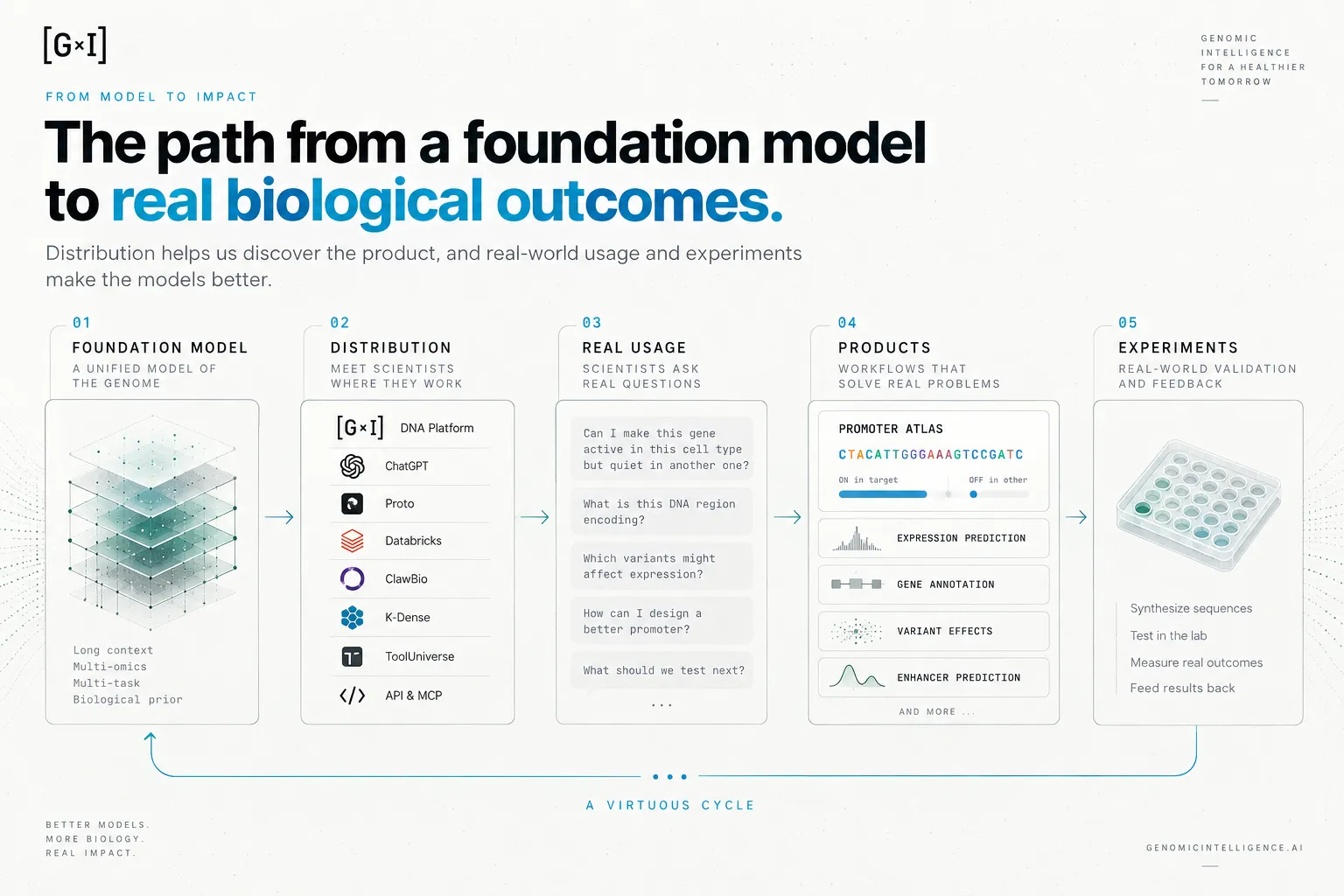
Marc Andreessen has argued that successful technology companies eventually become “distribution-centric rather than product-centric.” His point was largely about what happens after product-market fit: once you have something people want, distribution becomes one of the defining advantages of the company.
Building Genomic Intelligence has made me think distribution matters even earlier. For a foundation model, particularly in science, distribution can be part of how you discover the product in the first place.
This may sound slightly counterintuitive at a moment when so much of AI is defined by model benchmarks. Build a larger model, improve the benchmark score, release an API, and wait for developers to build something on top of it. That is an important part of the process, but I increasingly think it is not enough, especially when your eventual customer is not necessarily a software engineer.
At Genomic Intelligence, we are building genomic foundation models, and model quality is central to everything we do. We spend a tremendous amount of time on model architecture, long genomic context, training data, biological generalization, and evaluation.
But the better the models become, the more another question matters:
What is the actual product?
A foundation model can support many possible workflows. Only a small number of them will become products scientists rely on repeatedly. We do not think the answer should come only from brainstorming internally. Increasingly, we are using real usage, customer behavior, and distribution to help us find it.
Expose the models early
One of the first things we did was release the Genomic Intelligence DNA Platform.
We could have kept developing the models privately until everything felt finished. Instead, we wanted researchers to use them early and tell us what was useful, what was confusing, what was missing, and, most importantly, what they were actually trying to accomplish.
So we exposed promoter prediction, expression prediction, enhancer prediction, splice-site prediction, gene annotation, and other capabilities through a simple interface. The point was not that we already knew the perfect product. It was almost the opposite. We wanted to put the models in front of people and watch what happened.
- Which capabilities did people return to?
- Which predictions became part of larger workflows?
- Where did researchers get stuck?
- Which problems were important enough to pay to solve?
We deliberately encouraged this kind of exploration. We ran a challenge asking researchers and builders to use Genomic Intelligence models in ways we had not prescribed. One result was Marc Amil’s project turning genomic model predictions into a sequence-design workflow.
It gave us another useful signal. The model itself was valuable, but forcing researchers to move manually between different tools created unnecessary friction. That reinforced something we were already starting to believe: instead of expecting every scientist to come to us, Genomic Intelligence needed to become available inside the environments they already use.
That led us to integrate with Proto, so Genomic Intelligence models could become part of a broader biological design workflow. This captures how we increasingly think about product development: release capability, observe behavior, identify friction, and build around what people actually do.
Turn predictions into products
One workflow in particular kept becoming more interesting: promoter selection and design. Researchers were not simply asking, What is the predicted activity of this DNA sequence? They were asking a much more product-shaped question:
Can I make this gene active in this cell type but quiet in another one?
That is fundamentally different from a model prediction. It has a biological objective, constraints, and often requires multiple predictions across different contexts. Most importantly, it has a next action: produce a sequence that can be synthesized and tested.
That observation became our next product: Promoter Atlas. Instead of asking a scientist to operate a foundation model directly, Promoter Atlas starts with the biological specification. A researcher can describe where expression should be high, where it should be low, and what other constraints matter. The system searches and ranks natural and designed regulatory sequences, then returns candidates that can move toward synthesis and experimental validation.
The models became the intelligence layer underneath the product. The product bridges the gap between a model capability and the biological job a scientist needs to accomplish, adding context, constraints, orchestration, ranking, visualization, and a path into experimental validation.
When predictions start flowing into experiments, and experimental outcomes start flowing back into the system, the product becomes more than an interface around a foundation model. It becomes a learning loop.
We are beginning to see that loop take shape. We recently announced a pilot with the University of Minnesota Department of Surgery that brings Promoter Atlas into an oncolytic virus development program. The collaboration will evaluate AI-designed promoters experimentally, connecting Genomic Intelligence’s computational design with the Minnesota team’s preclinical cancer models.
Wet lab results are an unusually valuable source of feedback. They can tell us whether a sequence worked, where the model systematically succeeds or fails, which biological contexts need better representation, and where post-training or model adaptation could improve performance. Over time, this loop could become one of the most important advantages in scientific AI:
Model → product → experiment → model
Meet scientists where they work
Even after you identify a valuable workflow, another challenge remains: how does the scientist actually reach the model? If every potential customer were a software engineer, perhaps the answer would simply be: here is the API. But biology does not work that way.
Our users can be computational biologists, geneticists, cancer researchers, synthetic biologists, translational scientists, clinicians, or wet lab researchers. Their workflows are completely different. Some live in Python. Some work in notebooks. Some increasingly work through AI agents. Some want a graphical interface. Some use specialized biological software. Some simply want to ask a biological question without understanding the infrastructure underneath it.
If accessing a genomic foundation model requires all of these people to change the way they work, we have introduced unnecessary friction. The models should go where the scientists already are.
Today, Genomic Intelligence models are available through:
- DNA Platform
- API and MCP
- Scientific and agent environments: Proto, ClawBio, K-Dense, ToolUniverse, Phylo and others, with the current list here
- ChatGPT plugin
A researcher can start with a biological question in a conversation and let ChatGPT invoke specialized genomic models underneath it. The important part is not adding another logo to our integrations page. It is reducing the distance between a biological problem and the model capable of helping solve it.
A scientist should not need to understand our model architecture or API to ask: Can I make a gene active in glioblastoma but quiet in normal brain? Increasingly, the biological problem itself can become the interface.
Use distribution to discover product-market fit
The conventional technology sequence is usually described as: build product → find product-market fit → scale distribution. Scientific foundation models make that sequence less linear.
Each new surface exposes the technology to a somewhat different population. Those users bring different problems. Their questions reveal workflows. Repeated workflows reveal where a general capability is turning into a specific product. In biology, some of the resulting feedback eventually becomes experimental evidence.
The loop looks more like:
Model → distribution → usage → workflow → product → experiment → learning → better model and better product
This changes the questions a foundation model company has to answer:
- Who needs this capability badly enough that it changes what they can do?
- What complete workflow does it enable?
- How does that workflow produce an outcome the customer values?
- Where does that customer already work?
- How do we reduce the distance between having a biological problem and using our models to solve it?
Product and distribution stop being separate functions. Better distribution produces stronger product signals. Better products create deeper engagement. Experimental workflows generate biological feedback that can improve the models and make new products possible.
The durable asset is not just the model weights. It is the system forming around them: the models, the workflows learned from real usage, the products built around those workflows, the surfaces through which scientists access them, and eventually the experimental feedback generated when computational predictions encounter real biology. Each layer can make the others stronger.
What we are building toward
Our ambition at Genomic Intelligence is to build the intelligence layer for working with the genome.
We are still early, and I do not think anyone yet knows exactly what the dominant products and interfaces around biological foundation models will look like several years from now. That is precisely why I think it is important to get these models out of the lab, into real workflows, and as close as possible to scientists solving real problems.
The companies that matter in AI for science will not be defined only by who can train an impressive model. They will be defined by who can turn that intelligence into something scientists repeatedly use to make better decisions, design better experiments, and create things that were difficult or impossible before.
The model is the foundation. The product is the workflow. Distribution is how you discover it.