What does it take to post-train a genomic model well?
We want every experiment to help us build better genomic models and design better DNA. Our planned pilot with Surfacto is an initial step toward a continuous cycle of design, experimental feedback, and model improvement.
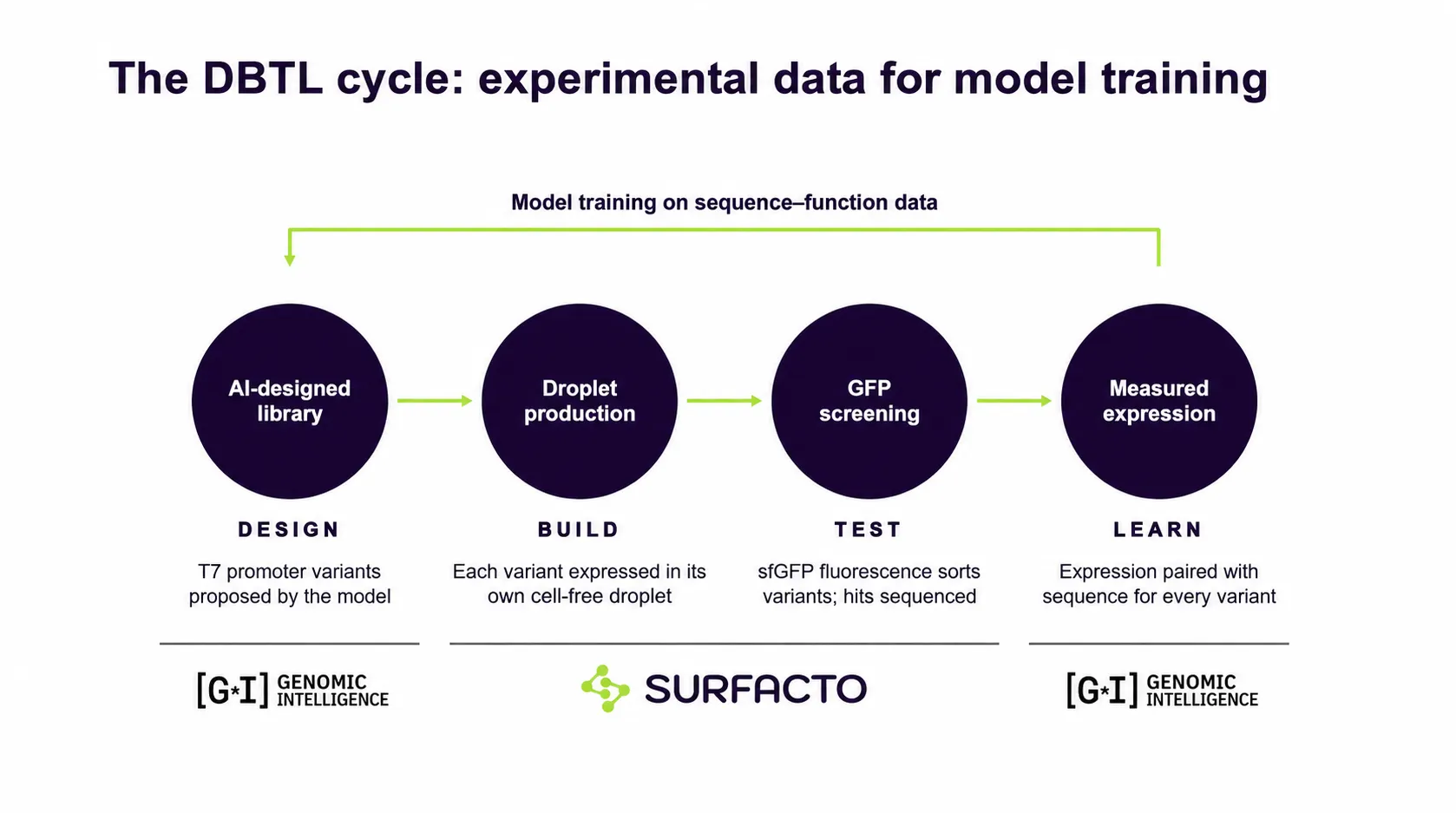
A genomic model can propose a DNA sequence. The experiment tells us what that sequence actually does. The opportunity is to connect the two: use models to guide experiments, use experimental results to improve the models, and use those improved models to design the next round.
At Genomic Intelligence, this is the discovery loop we are building. Our ambition is for each round of experiments to improve our ability to design DNA with a desired function and help us choose what to test next.
That brings us to a question we spend a lot of time thinking about: what does it take to post-train a genomic model well? Alongside architecture and pretraining, we need the right experimental data to improve a model for a particular biological task. The experiments and the learning process have to be designed together.
From a predicted sequence to a useful biological design
When someone asks us to design a promoter, they usually have a specific outcome in mind. They want a sequence that produces a certain level of expression under particular conditions. To make models more useful for that work, we need experimental measurements that tell us how candidate sequences actually behave, and a way to bring those measurements back into model development.
The longer-term opportunity is a repeatable process in which models guide experiments and experimental feedback guides both model improvement and the next round of designs. If that loop works, the value of an experiment extends beyond the sequence being tested: its results can help improve future design decisions.
This is the direction we are taking through a partnership with Surfacto.
Starting with a question we can test
The pilot focuses on T7 promoter variants in a cell-free expression system. We plan to explore droplet-based functional screening using superfolder GFP as a fluorescent reporter, with sequencing of promoter variants to connect their sequences with measured expression. Our collaboration will follow Design-Build-Test-Learn (DBTL) cycles, in which models guide experiments and the resulting lab data inform subsequent model development and design.
The initial goal is to assess whether this setup can quantify differences in promoter-dependent expression and generate useful sequence–function data. The library, controls and experimental parameters will be defined together during technical scoping. Before deciding how to use the results for post-training, we need to establish what the assay measures reliably and how much useful information it provides about the sequences being tested.
It is a deliberately focused starting point: a defined biological task, a measurable outcome, and a path to testing whether experimental feedback can improve the next round of design.
The experiment is part of the model-development problem
For us, the broader question is what makes an experimental dataset useful for improving a genomic model. We care about how sequences are selected, whether measurements are reproducible, and whether the resulting data help us distinguish between designs that a model currently scores similarly.
There is also an important distinction between using experiments to evaluate a model and using them to improve it. A model can help choose candidates for testing. Experimental results can then reveal where its predictions are useful and where they need work. With suitable data, those results could support task-specific post-training and help guide subsequent rounds of design.
That creates a demanding evaluation question: does a model become better at designing new sequences after learning from experimental feedback? This will be measured on sequences held out from training and, ultimately, through another DBTL iteration.
Building a discovery loop that improves with use
Our thesis is that genomic models and the systems that generate their experimental feedback should develop together. A useful discovery loop would connect sequence design, reliable measurements, model improvement, and the selection of the next experiment. Over successive cycles, we want useful data and better design decisions to build on one another.
Our T7 pilot is an early step toward that vision. It will test a specific screening approach in a defined system, with the results evaluated within that context. The immediate milestone is to establish a useful source of experimental feedback. The longer-term test is whether learning from that feedback leads to better designs in the next round.
I am excited about this because building useful genomic models requires close collaboration between the people developing the models and the people designing the experiments. Decisions on each side affect what the other can learn.
For Genomic Intelligence, closing this loop is central to how we want to build better genomic models and make them useful for biological design. We want every experiment to help us make the next design better.