Your DNA Holds Clues to a Healthier Life. We’re Building AI to Read Them.
Genetic risk scores can flag inherited susceptibility. The next step is connecting that signal to biology, earlier prevention, and better drug targets.
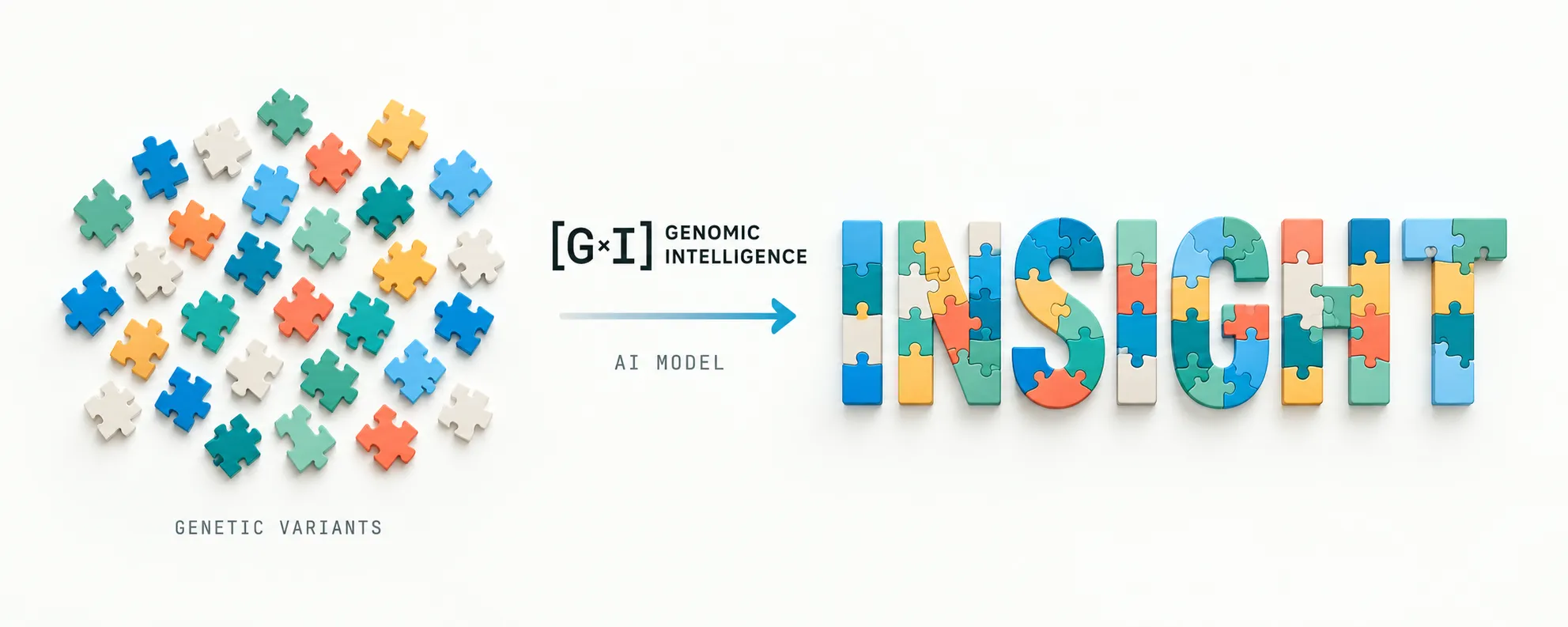
Your genome can carry clues to disease risk years, sometimes decades, before symptoms appear. That is one of the most compelling promises of genomics: the possibility of acting while there is still time to change an outcome.
But knowing that someone has elevated risk is only the beginning. The more useful question is what that risk means biologically, and what we can do with that information.
Building Genomic Intelligence has made me increasingly interested in this gap. We can read a person’s DNA. We can calculate genetic risk scores. We are still much less capable of explaining how the many differences in that genome come together to influence disease.
The next step is connecting inherited risk to a biological mechanism that can be tested and, eventually, acted on.
A risk score is a starting point
Polygenic risk scores, or PRS, combine information from thousands or millions of DNA differences into an estimate of inherited susceptibility to a disease.
In a landmark study of coronary artery disease, researchers identified about 8 percent of the studied population with more than threefold increased risk based on their polygenic score. Because these inherited differences are present long before symptoms, they could help identify people who might benefit from earlier prevention or closer monitoring, alongside other clinical information.
That is valuable. But a score alone does not necessarily tell us which genes are involved, which cells matter, or what is going wrong inside them.
For a patient, the practical question is whether the information changes a decision. For a drug developer, it is whether the signal points to a mechanism worth investigating.
Both require us to connect a statistical association to biology.
Human genetics has already shown the path
PCSK9 is a useful example of what becomes possible when that connection is made.
Researchers found that people carrying certain natural variants in PCSK9 had lower LDL cholesterol and fewer coronary events. Those observations helped validate the protein as a therapeutic target. Medicines that inhibit PCSK9 later reduced cardiovascular events in clinical trials.
A difference in DNA pointed to a biological mechanism. That mechanism helped establish a direction for drug development.
I think this is one of the most important reasons to build better genomic models. Human genomes contain many more associations we do not yet know how to interpret. Some may lead to useful targets. Others may help us understand why people develop the same disease through different biological routes.
The challenge is turning those signals into specific hypotheses.
Why the biology is difficult to read
Many variants associated with common disease sit outside the regions that encode proteins. They can affect when a gene is active, in which cells, and how much of its product is made.
That makes interpretation difficult. A variant’s effect may depend on the tissue or biological context. Nearby variants are often inherited together, making it hard to separate the causal change from others that travel with it. Regulatory sequences can also act far from the genes they control.
There is another practical limitation. Risk scores do not transfer equally well across ancestry groups, partly because variant frequencies and patterns of inheritance differ, and because the underlying studies have not represented all populations equally.
So we can have a strong statistical signal and still lack a useful explanation of what it means.
More DNA data helps. We also need better ways to interpret it.
From DNA differences to predicted gene activity
This is where I think genomic AI can make an important contribution.
Imagine taking the DNA differences in a person’s genome and asking what they might do to gene activity in particular cells: liver cells, pancreatic cells, neurons, or immune cells.
Two people may carry different variants that produce a similar predicted effect on the same gene in the same tissue. Looking at each variant separately can obscure that connection. A model that captures their functional effects could help bring it into view.
We could then ask whether those predicted changes in gene activity are associated with disease in a patient cohort. Instead of ending with a list of variants, the analysis could point to a smaller set of genes, tissues, and pathways for researchers to investigate.
The useful output is a hypothesis a biologist can test.
A predicted expression change does not establish causality. But it can help researchers decide which experiments would be most informative, and which possible mechanisms deserve closer attention.
At Genomic Intelligence, this is the direction we are building toward. Our expression model combines DNA sequence with a description of the biological context to predict gene activity. Our broader foundation model program focuses on learning across species and reading longer stretches of DNA, because biological regulation often depends on information beyond the immediate neighborhood of a gene.
The goal is to make genomic variation easier to investigate at the level where biology happens.
A concrete example: GLP1R
We have already used this approach to investigate GLP1R, the gene encoding the receptor targeted by medicines such as Ozempic.
We screened 2,734 nearby DNA changes and identified 229 candidates with predicted effects on GLP1R expression larger in magnitude than the reference variant used in our analysis.
Those results give us a ranked set of candidates for experimental follow-up. They do not tell us who will respond to Ozempic, or establish that the predicted expression changes occur in patients.
This distinction matters. A useful model should help us choose the next experiment and make clear what that experiment still needs to establish.
For this analysis, that means testing whether selected variants alter GLP1R expression in relevant biological systems. Connecting those effects to treatment response would require further evidence.
What a more useful genomic report could look like
Sequencing has become much cheaper, and resources such as UK Biobank now connect whole-genome sequencing with health information for roughly half a million participants. At the same time, genomic AI models are becoming more capable of predicting biological activity from sequence.
Bringing these pieces together creates an opportunity to test whether functional predictions can improve how we understand inherited risk.
A future genomic report could connect an elevated risk estimate to the genes and pathways that appear to contribute to it. It could identify the tissues where those effects may matter. With sufficient experimental and clinical evidence, it could also help inform what to monitor and which interventions deserve consideration.
For researchers, the same analysis could suggest a target, a relevant cell model, or an experiment that distinguishes between competing explanations.
We are not there yet. These systems need to demonstrate that they add value beyond strong PRS and clinical baselines, that their proposed mechanisms survive experimental testing, and that their performance holds across diverse populations.
Those requirements are central to the work. A biological explanation is useful only if it holds up.
What excites me is the possibility of moving the starting point of medicine earlier. Inherited variation is already there before disease develops. If we can interpret it well enough, we may be able to use that information to guide prevention and uncover mechanisms worth targeting.
Your genome is not your destiny. It can be a starting point for understanding what to do next.
That is the future we are building toward at Genomic Intelligence. If you work with patient cohorts, disease models, or drug discovery, we would like to collaborate on testing this approach.