Genomic Intelligence is where the agents already are
Genomic Intelligence models are now callable from a growing set of agent platforms, and from any MCP client. One integration standard, a REST API and a hosted MCP server, is what made each of those a short piece of configuration rather than a project.
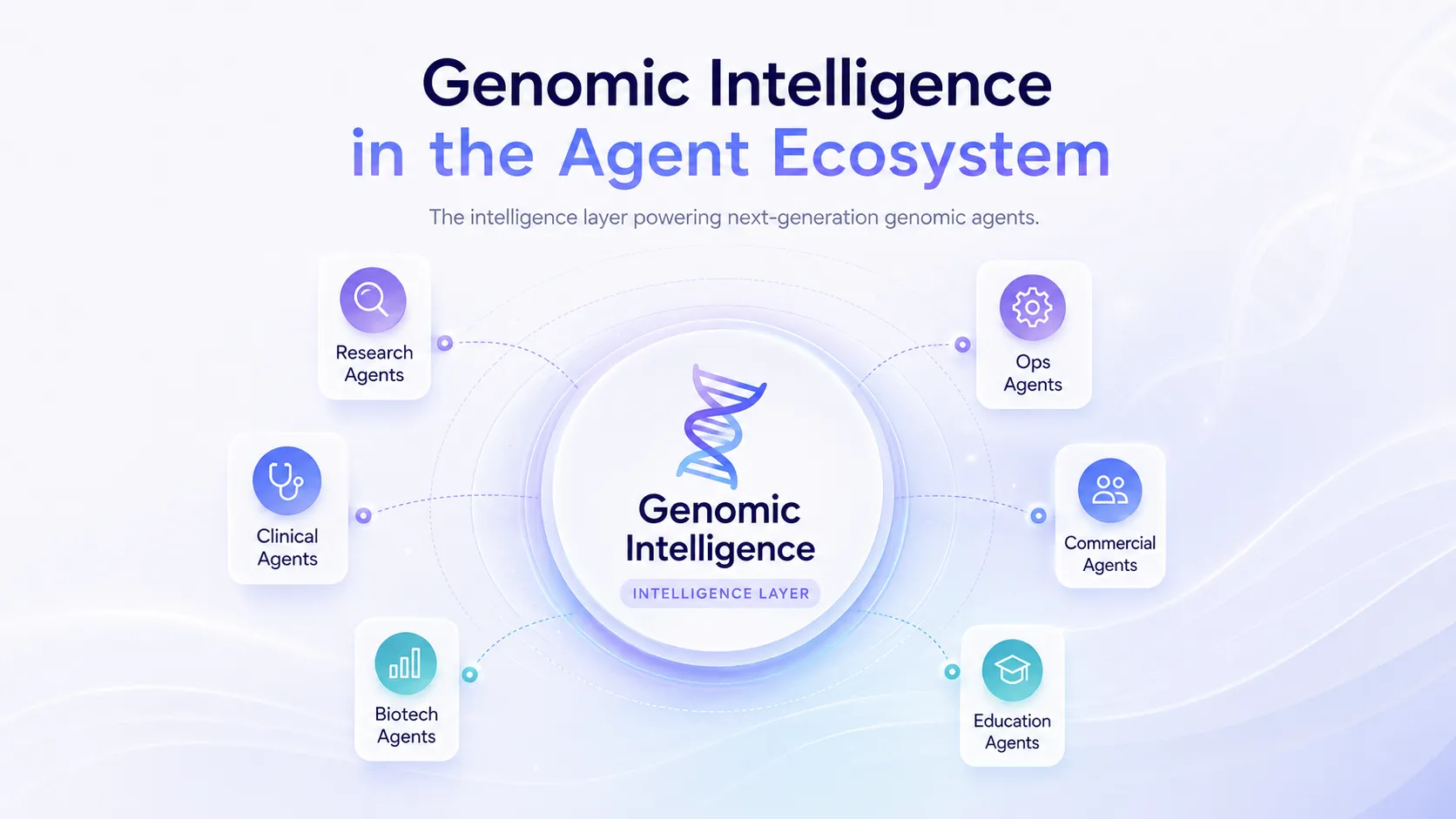
A researcher working in Biomni Lab, ClawBio, or K-Dense can now ask for a promoter scan or an expression prediction and get one, without leaving the environment they were already in. Over the past months, Genomic Intelligence models have become callable from a growing number of agent platforms.
Each of those integrations landed quickly, and for the same reason: the Genomic Intelligence platform exposes one integration standard, and it is a small one.
One standard, two entry points
The platform is reachable two ways:
- A REST API:
https://api.genomicintelligence.ai/v1 - A hosted MCP server:
https://mcp.genomicintelligence.ai/mcp
Six tasks run behind both: promoter, splice, enhancer, chromatin, expression, and gene annotation, plus a composite find-genes-then-predict-expression workflow. The full contract is at docs.genomicintelligence.ai.
Both entry points are hosted. Inference runs on our GPUs, which means an agent platform adding Genomic Intelligence models takes on no model weights, no CUDA environment, and no download step. The integration is a network call. It also means the platform stays current automatically: when we ship a task or improve a model, connected agents pick it up without a version bump on their side.
The MCP server is public and needs no API key. It runs against a shared demo
quota, so a maintainer evaluating the models can connect and try them in a couple of
minutes before deciding whether it belongs in their framework. A gi_ key
raises the quota and unlocks the REST path.
What an integration actually looks like
For a framework that speaks MCP, adding Genomic Intelligence platform access means pointing at the server:
{
  "mcpServers": {
    "genomic-intelligence": {
      "url": "https://mcp.genomicintelligence.ai/mcp"
    }
  }
}
The client connects, discovers the available tools from the server, and exposes them to the agent. This is the same configuration that works in Claude Desktop, Claude Code, and Cursor. We wrote about why we built that server in Why we built the Genomic Intelligence MCP server, and the setup guide covers the per-client details.
Agent-skill ecosystems want something slightly different: a Markdown file
describing when to reach for a tool and how to call it, plus a thin script.
Because the REST endpoint is plain HTTP with JSON, that script is a few dozen
lines of requests, with no SDK to install or keep in sync. This is the shape
running in ClawBio and in
K-Dense’s scientific-agent-skills,
where the skill covers all six tasks plus the composite workflow.
What it looks like in use
Three worked examples, each run end to end inside a partner environment rather than against our API directly:
- Detecting a promoter deletion with ClawBio takes a regulatory variant from sequence to interpretation.
- Predicting expression and optimizing promoters with ClawBio scores candidate sequences and iterates on them.
- Designing a glioblastoma-selective promoter in Biomni Lab uses the expression model as a scoring oracle inside a 100-cycle optimization loop, with the full agent replay linked at the end.
Where the models run today
| Platform | How it connects |
|---|---|
| Biomni Lab | REST, via Phylo |
| ClawBio | Agent skills over REST |
K-Dense scientific-agent-skills | Agent skill over REST and hosted MCP |
| Claude Desktop, Claude Code, Cursor, and other MCP clients | Hosted MCP, keyless |
The server is also listed in the official MCP Registry, so registry-aware clients can find it by name with no configuration written by hand. More on that in Genomic Intelligence is now in the official MCP Registry.
More integrations are in progress with other platforms, and we will write those up as they land.
Why we build it this way
The aim is for genome-scale prediction to be something an agent simply calls, the way it calls search or a code interpreter. Agents are good at planning, orchestrating, and stitching steps together; what they need from us is a specialized biological model at the end of a well-described call, available the moment they reach for it.
Keeping the integration surface small is how that happens. It means a maintainer can read the whole contract in one sitting, try it without asking us for credentials, and ship it in an afternoon.
If you are building an agent framework and want Genomic Intelligence models in
it, you do not need to talk to us first. Point an MCP client at
https://mcp.genomicintelligence.ai/mcp, or read the
REST contract. If you need
a higher quota or a production deployment, we are at
contact@genomicintelligence.ai.