Finding genes in unannotated genomes with ClawBio and Genomic Intelligence
A ClawBio + Genomic Intelligence walkthrough for gene finding, splice-site annotation, CDS prediction, and protein-function inference from raw DNA sequence.
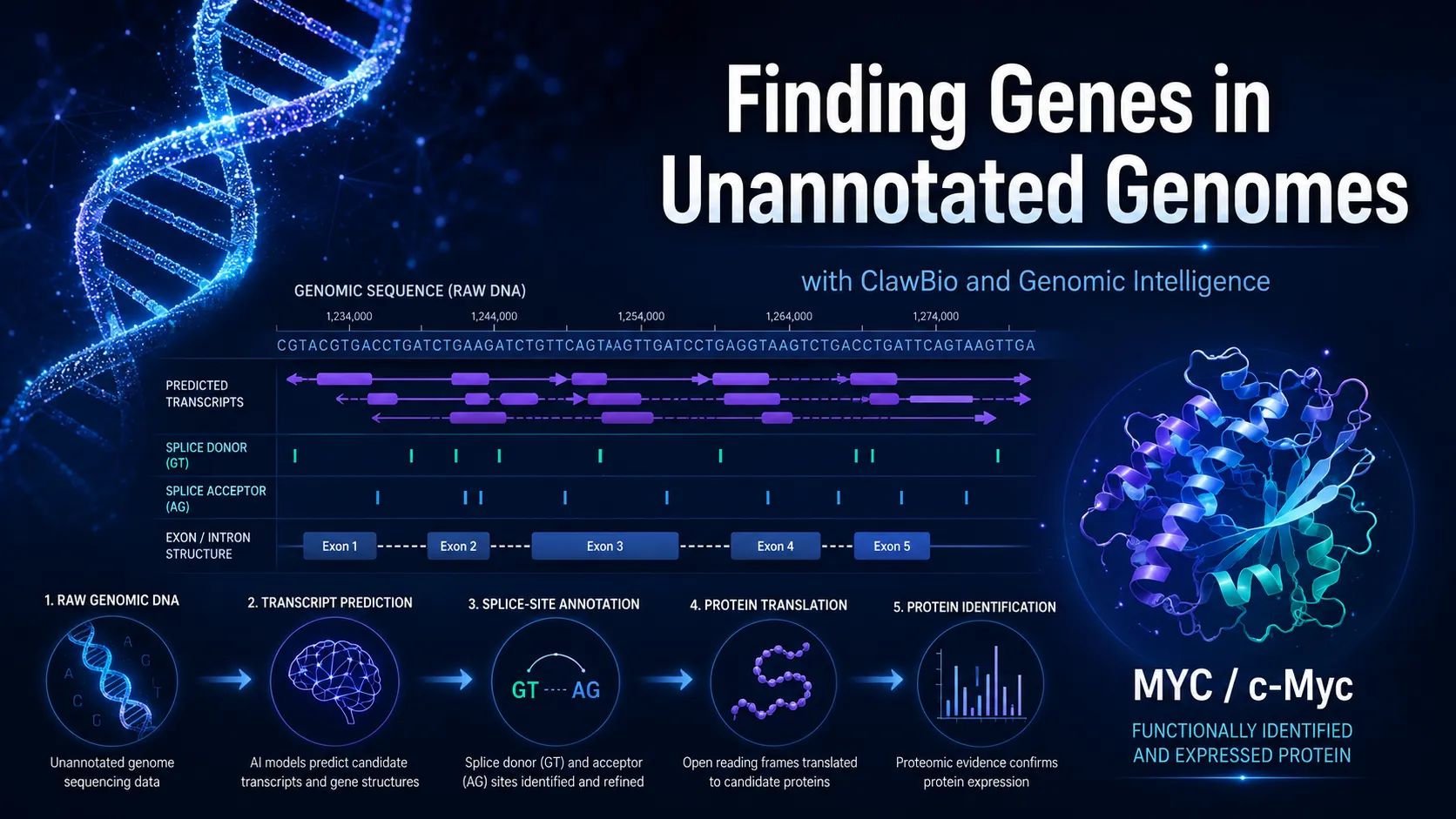
TL;DR
ClawBio lets you run biology-focused AI workflows as Codex or Claude skills.
In this walkthrough, we use the gi-annotation and gi-splice skills from Genomic Intelligence to analyze a 120 kb genomic region as if it were unannotated DNA.
The result is simple but important:
- The gene-finding model predicts candidate plus-strand transcript intervals.
- The splicing model identifies donor and acceptor signals that support a main internal intron.
- The reconstructed transcript yields a 439 aa candidate protein.
- BLASTP identifies the protein as MYC / c-Myc with 99.77% identity over 439 aa.
This post continues our series on ClawBio + Genomic Intelligence skills.
If you want to learn more about ClawBio or Genomic Intelligence, join our upcoming webinar: luma.com/6mov0cxa.
Most genomic analyses start with something we already know: reference gene models, transcript databases, RNA-seq evidence, or homology to known proteins.
But what if we work with a non-model organism where we have only raw genomic DNA?
In this post, I want to show how an agentic biology workflow can take an apparently unannotated genomic region, predict possible transcripts, infer exon-intron structure, extract candidate coding sequences, and then predict the likely protein function.
You can also read our previous posts on gene expression prediction and promoter variant interpretation:
- Using ClawBio and Genomic Intelligence Skills to Predict Gene Expression and Optimize Promoters
- Using ClawBio Agents and Genomic Intelligence to Detect a Disease-Causing Promoter Deletion
The idea
We will use a human genomic region as a validation example, because we can check whether the workflow recovers a known gene.
But the same logic can be applied to unannotated genomes from vertebrate species.
NB: Our internal validation shows that model performance drops when applied outside vertebrates. If you want to use dedicated models for plants, invertebrates, or other domains, please contact us.
The workflow is simple:
- Fetch a genomic region.
- Use the Genomic Intelligence gene-finding model to predict possible transcripts.
- Use the Genomic Intelligence splicing model to predict potential splice donor and acceptor sites.
- Combine transcript predictions and splice-site predictions to infer exon and intron structure.
- Extract predicted exon sequences.
- Search for candidate coding sequences.
- Translate them into proteins.
- BLAST the proteins to infer what the region encodes.
In other words:
raw genomic DNA
→ transcript prediction
→ splice-site annotation
→ exon/intron model
→ CDS prediction
→ protein translation
→ BLAST-based functional interpretation
This is the kind of workflow where agentic systems are useful. Each individual step is simple, but the full chain requires careful file handling, coordinate conversion, sequence extraction, translation, and interpretation.
Before we start, let me briefly explain what Genomic Intelligence and ClawBio are.
What is Genomic Intelligence?
Genomic Intelligence is a platform for sequence-to-function prediction.
GI builds AI models that can read DNA sequence and predict biological function: where genes are located, where promoters and splice sites are, and how genetic variants may affect health.
In this tutorial, we use two Genomic Intelligence models:
- a gene-finding / annotation model, which predicts possible transcript regions directly from DNA sequence;
- a splicing model, which predicts potential splice donor and acceptor sites.
Together, these models allow us to move from raw genomic sequence to a first-pass gene model.
What is ClawBio?
ClawBio is a collection of biology-oriented skills for AI coding agents such as Codex or Claude Code.
Each skill is a self-contained workflow with instructions, code, examples, validation rules, and reproducibility support.
Instead of asking an AI agent to invent a bioinformatics pipeline from scratch, you point it to a specific skill, such as:
skills/gi-annotationor:
skills/gi-spliceThe skill tells the agent what inputs are valid, how to call the model, how to save outputs, and what assumptions are allowed.
This matters because biological workflows are easy to get subtly wrong. For example, genomic coordinates can be 0-based or 1-based, intervals can be open or closed, and strand orientation can change how splice sites and coding sequences should be interpreted.
In this workflow, ClawBio lets the agent fetch the sequence, run GI models, combine predictions, extract candidate coding sequences, translate proteins, and save a reproducible report.
The prompt
Here is the short prompt I used with Codex and ClawBio:
Use the ClawBio skills located in skills/.

Task:
Analyze the human hg38 genomic region chr8:127,680,000-127,800,000.

Workflow:
1. Fetch the sequence of this region from the human hg38 genome and save it as FASTA.
2. Run the GI gene-finding / annotation tool to identify possible transcripts in this region.
3. Run the GI splicing tool to annotate potential splice donor and acceptor sites.
4. Overlap the predicted splice sites with the predicted transcripts and infer likely exon and intron structures.
5. Based on the predicted exon sequences, identify potential coding sequences / ORFs.
6. Translate the candidate CDS sequences into proteins.
7. BLAST the predicted protein sequences to infer what protein may be encoded in this region.

Requirements:
- Read the relevant SKILL.md files before running each tool.
- Use GI_API_KEY from the environment when calling GI tools.
- Treat the region as unknown during prediction; do not use known gene annotations before the GI gene-finding, splicing, ORF, and BLAST steps are complete.
- Save all outputs under results/gene-finding-chr8/.
- Write a short final report summarizing the predicted transcripts, splice sites, exon/intron structure, candidate CDS, BLAST hits, and likely encoded protein.
Step 1: Fetching the region
The agent first fetched the exact hg38 interval and saved it as FASTA:
results/gene-finding-chr8/chr8_127680000_127800000_hg38.faIt also checked that the sequence length was correct:
120,001 bpThis is important. In genome workflows, off-by-one coordinate mistakes are extremely easy to make.
The user-facing coordinate system was 1-based inclusive, while the UCSC API uses 0-based half-open intervals. The agent handled this conversion explicitly.
Step 2: Predicting transcripts with GI gene finding
Next, the agent ran the GI gene-finding / annotation model.
The GI annotation model predicted four transcript intervals on the plus strand.
At this stage, the output was not yet a full exon-by-exon gene model. It gave candidate transcript regions from sequence alone.
To go further, we need splice-site information.
Step 3: Predicting splice sites
The agent then ran the GI splicing model on the same genomic sequence.
This produced predicted splice donor and acceptor sites.
The important part is that splice prediction is independent evidence: it does not simply repeat the transcript interval prediction. It gives local signals for where introns may start and end.
The transcript predictions and splice-site predictions were then overlapped.
The result was a coherent structure: the predicted transcripts all contained a main internal intron supported by the splice-site model.
Step 4: Inferring exon and intron structure
The agent combined:
- GI transcript intervals;
- GI donor and acceptor predictions;
- canonical splice motifs;
- transcript strand;
- genomic coordinates.
From this, it inferred likely exon and intron structures.
This is the key biological reasoning step.
A gene-finding model may say: “there is probably a transcript here.”
A splicing model may say: “there are likely donor and acceptor sites here.”
But the agentic workflow combines them into a transcript model that can be used for CDS prediction.
Step 5: Finding ORFs and translating proteins
After reconstructing candidate transcript sequences, the agent searched for open reading frames.
The best candidate ORF encoded a protein of:
439 amino acidsThis is already a strong clue. A 439 aa protein is not just a tiny random ORF. It is a plausible protein-coding gene product.
The translated protein sequence was saved and then used for BLAST.
Step 6: BLAST-based functional interpretation
Finally, the agent ran BLASTP against Swiss-Prot.
The top hit was:
Myc proto-oncogene protein
Swiss-Prot: sp|P01106.2|
Identity: 99.77%
Alignment length: 439 aa
E-value: 0.0
So, starting only from raw genomic sequence and without using known gene annotations during prediction, the workflow recovered a protein that BLAST identifies as:
MYC / c-MycYou can go to UCSC now to validate: the region indeed contains the c-Myc gene.
What the workflow produced
The agent saved all outputs under:
results/gene-finding-chr8/Main outputs included:
chr8_127680000_127800000_hg38.fa
gi-annotation/result.json
gi-splice/result.json
transcript_structures_orfs.json
candidate_proteins_unique.faa
blastp/blastp_swissprot_top_hits.tsv
report.md
This matters because the workflow is not just a chat answer. It creates files that can be inspected, reused, and audited.
Why this matters
Genome sequencing is no longer the bottleneck. The hard part is interpretation.
Many species have genomes that are only partially annotated. Even in well-studied organisms, there are poorly characterized loci, alternative transcripts, non-canonical isoforms, and regions where annotation is uncertain.
A workflow like this gives us a way to move from sequence to biological hypothesis:
- Where are the genes?
- Where are the exons?
- What protein could this encode?
- What known proteins does it resemble?
For human hg38, this is a validation demo.
For unannotated vertebrate genomes, the same workflow becomes a discovery tool.
Conclusion
In this example, an agentic ClawBio workflow took a 120 kb genomic region, treated it as unknown DNA, predicted transcripts with GI gene finding, annotated splice sites with GI splicing, inferred exon/intron structure, extracted candidate ORFs, translated proteins, and used BLAST to infer function.
The final protein hit was MYC / c-Myc.
That is a compact but powerful demonstration of how genome-scale AI can support gene discovery and functional annotation.
Today we used a human region so we could validate the answer.
The same logic can be applied to unannotated vertebrate genomes.